Introduction
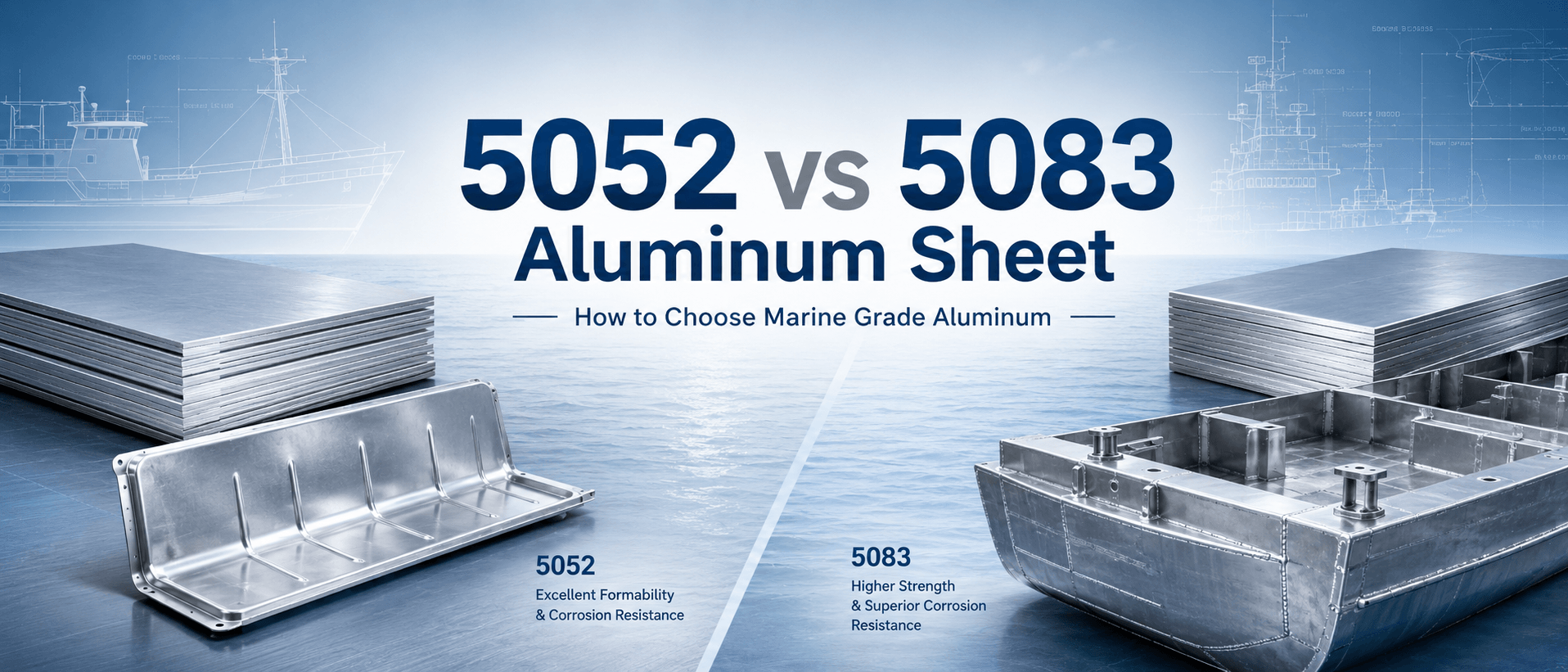
When comparing 5052 vs 5083 Aluminum Sheet, buyers should choose 5052 aluminum sheet for formed parts, light marine panels, covers, tanks, decorative panels and cost-sensitive fabrication where good corrosion resistance and excellent formability are required. Choose 5083 aluminum sheet for marine grade aluminum applications such as boat hulls, ship panels, decks, welded marine structures, offshore platforms and LNG-related equipment where higher strength, better seawater resistance and stronger welded performance are needed. In simple terms, 5052 is better for forming and economical sheet metal work, while 5083 is better for demanding marine structures and seawater-exposed components.
Both 5052 and 5083 belong to the 5xxx series aluminum-magnesium alloys. They are non-heat-treatable aluminum alloys, which means their strength is mainly controlled by magnesium content and strain hardening rather than solution heat treatment and artificial aging. This gives both materials good weldability, good corrosion resistance and reliable performance in many marine and industrial environments.
For procurement teams, the correct choice depends on application scenario, seawater exposure, strength requirement, forming process, welding method, thickness, temper, standard, certificate, inspection requirement and project budget. Buyers should specify grade, temper, thickness, width, length, surface finish, tolerance, EN 10204 3.1 MTC, batch number control, dimensional inspection and export packaging before placing an order.
What Are 5052 and 5083 Aluminum Sheet?
5052 Aluminum Sheet is an aluminum-magnesium alloy known for good corrosion resistance, excellent formability, good weldability and smooth surface quality. It is widely used for sheet metal parts, marine covers, fuel tanks, electronic enclosures, truck panels, architectural panels and general fabrication. It is easier to bend and form than 5083 in many applications.
5083 Aluminum Sheet is a higher-magnesium aluminum alloy designed for stronger marine corrosion resistance and higher strength than 5052. It is commonly used in shipbuilding, boat hulls, marine structures, offshore equipment, pressure vessels, cryogenic equipment, transportation parts and welded structural components. For seawater exposure and heavy-duty marine applications, 5083 is often preferred over 5052.
Fast Buyer Recommendation
| Application Condition | Recommended Grade | Reason |
|---|---|---|
| Light marine panels, covers and formed parts | 5052 Aluminum Sheet | Excellent formability, good corrosion resistance and lower cost |
| Boat hulls, decks and welded marine structures | 5083 Aluminum Sheet | Higher strength and stronger seawater corrosion resistance |
| Cost-sensitive sheet metal fabrication | 5052 Aluminum Sheet | More economical for general corrosion-resistant sheet applications |
| Shipbuilding and offshore projects | 5083-H116 / 5083-H321 | Marine tempers provide improved resistance to exfoliation and intergranular corrosion |
| Bending, deep forming and panel fabrication | 5052-O / 5052-H32 | Better forming performance than 5083 in many sheet applications |
Chemical Composition Comparison
The main difference between 5052 and 5083 aluminum sheet comes from magnesium content and alloy design. 5083 contains more magnesium and manganese than 5052, which gives it higher strength and better performance in demanding marine environments. 5052 has lower magnesium content, making it easier to form while still offering good corrosion resistance.
| Element | 5052 Aluminum Typical Range (%) | 5083 Aluminum Typical Range (%) | Material Selection Note |
|---|---|---|---|
| Aluminum (Al) | Balance | Balance | Base metal providing low density, corrosion resistance and workability |
| Magnesium (Mg) | 2.20 – 2.80 | 4.00 – 4.90 | Higher magnesium gives 5083 higher strength and stronger marine performance |
| Chromium (Cr) | 0.15 – 0.35 | 0.05 – 0.25 | Supports grain structure and corrosion-related stability |
| Manganese (Mn) | Max 0.10 | 0.40 – 1.00 | Higher manganese supports 5083 strength and structural stability |
| Iron (Fe) | Max 0.40 | Max 0.40 | Controlled impurity element affecting surface quality and corrosion performance |
| Silicon (Si) | Max 0.25 | Max 0.40 | Controlled residual element for processing consistency |
| Copper (Cu) | Max 0.10 | Max 0.10 | Low copper content supports marine corrosion resistance |
| Zinc (Zn) | Max 0.10 | Max 0.25 | Controlled residual element; should match certificate requirement |
Mechanical Properties and Temper Selection
5052 and 5083 are both non-heat-treatable aluminum alloys, so their mechanical properties are mainly determined by temper. 5052 is often supplied in O, H32, H34 and H112 tempers. 5083 is commonly supplied in O, H111, H112, H116 and H321 tempers. For marine grade aluminum, 5083-H116 and 5083-H321 are frequently used when long-term seawater resistance and shipbuilding requirements are important.
| Property | 5052 Aluminum Sheet | 5083 Aluminum Sheet | Buyer Selection Note |
|---|---|---|---|
| Strength | Medium strength, suitable for general sheet parts | Higher strength than 5052, especially in structural marine applications | Choose 5083 when structural load and marine strength are important |
| Formability | Excellent | Good, but generally less formable than 5052 | Choose 5052 for bending, forming and sheet metal fabrication |
| Weldability | Good | Excellent for marine structures | Both can be welded, but 5083 is preferred for heavy welded marine structures |
| Marine Corrosion Resistance | Good | Excellent | Choose 5083 for stronger seawater exposure |
| Typical Tempers | O, H32, H34, H112 | O, H111, H112, H116, H321 | Temper must be clearly stated in purchase order and MTC |
| Cost | Usually lower | Usually higher | Choose 5052 when 5083 strength and marine performance are not required |
Common Temper Recommendations
| Temper | Applicable Grade | Recommended Use |
|---|---|---|
| O | 5052 / 5083 | Bending, forming, spinning and shaped sheet metal parts |
| H32 / H34 | 5052 | General sheet metal panels, tanks, covers and decorative parts |
| H111 / H112 | 5083 | Marine fabrication, welded structures and transportation parts |
| H116 / H321 | 5083 | Boat hulls, shipbuilding, offshore structures and seawater-exposed marine components |
Applicable Standards and Equivalent Grades
5052 and 5083 aluminum sheets can be supplied according to international aluminum standards. For marine grade aluminum procurement, buyers should confirm standard, grade, temper, thickness tolerance, flatness, surface finish and certificate requirements. Shipbuilding and offshore projects may also require classification society approval.
| Standard / Grade | 5052 Aluminum Sheet | 5083 Aluminum Sheet | Common Procurement Use |
|---|---|---|---|
| AA Grade | AA 5052 | AA 5083 | General international alloy identification |
| EN Designation | EN AW-5052 | EN AW-5083 | European drawings, engineering projects and export specifications |
| ASTM Standard | ASTM B209 | ASTM B209 | Aluminum and aluminum-alloy sheet and plate specification |
| EN Standards | EN 485 / EN 573 | EN 485 / EN 573 | European mechanical, dimensional and chemical requirements |
| JIS Grade | A5052 | A5083 | Japanese and Asian market specifications |
| GB Grade | 5052 | 5083 | China-origin aluminum sheet and plate supply with export documentation |
Quality Testing and Material Traceability
For 5052 and 5083 aluminum sheet procurement, quality control should focus on grade identity, temper, mechanical properties, chemical composition, thickness tolerance, flatness, surface quality and export packing. For marine grade aluminum, buyers should pay special attention to 5083-H116 or 5083-H321 certification and classification society approval where required.
Certificate and Inspection Checklist
| Inspection / Document Item | What to Check | Why It Matters |
|---|---|---|
| EN 10204 3.1 MTC | Grade, temper, standard, batch number, chemical composition, mechanical properties and size | Confirms batch-specific material quality and supports project documentation |
| Batch Number Control | Batch number on label, packing list and MTC must be consistent | Prevents mixed material supply and supports traceability |
| Temper Verification | Confirm O, H32, H34, H111, H112, H116 or H321 according to order | Wrong temper may affect strength, forming, corrosion resistance and marine compliance |
| Chemical Analysis | Check Mg, Mn, Cr, Fe, Si, Cu, Zn and other elements | Helps distinguish 5052 from 5083 and prevents wrong-grade supply |
| Mechanical Testing | Tensile strength, yield strength, elongation and hardness where required | Verifies whether the sheet meets forming, structural or marine design requirements |
| Dimensional Inspection | Thickness, width, length, flatness, diagonal tolerance and edge condition | Important for cutting, bending, welding, assembly and installation |
| Third-party Inspection | SGS, BV, TUV, Intertek or customer-appointed inspection before shipment | Provides additional confidence for export orders and marine projects |
Comparison With Similar Aluminum Materials
5052 and 5083 are often compared with 5754, 5086, 6061 and 7075 aluminum sheets. The correct choice depends on strength, corrosion resistance, weldability, formability, surface quality and total cost. For marine grade aluminum sheet, 5083 and 5086 are frequently selected for stronger seawater service, while 5052 and 5754 are often used for lighter sheet metal parts.
| Material | Marine Corrosion Resistance | Strength | Cost Level | Best-use Recommendation |
|---|---|---|---|---|
| 5052 Aluminum Sheet | Good | Medium | Moderate | Formed parts, covers, tanks, panels, light marine components and general fabrication |
| 5083 Aluminum Sheet | Excellent | High among non-heat-treatable aluminum alloys | Higher than 5052 in many cases | Boat hulls, ship panels, decks, welded marine structures and offshore applications |
| 5086 Aluminum Sheet | Excellent | Medium to high | Moderate to high | Marine structures, hulls and welded assemblies similar to 5083 applications |
| 5754 Aluminum Sheet | Good | Medium | Moderate | Transportation, automotive, marine panels and general corrosion-resistant fabrication |
| 6061 Aluminum Sheet | Good but generally lower than 5083 in seawater service | Medium to high in T6/T651 | Moderate | Machined parts, frames, structures and non-critical marine hardware |
| 7075 Aluminum Sheet | Lower; protection required | Very high | High | Aerospace, high-strength tooling and performance parts, not preferred for welded marine sheets |
Industrial Applications of 5052 and 5083 Aluminum Sheet
5052 and 5083 aluminum sheets are both used in marine and industrial applications, but their application focus is different. 5052 is more often used for lighter sheet metal parts, formed components and economical fabrication. 5083 is more often used for marine structures, welded panels and components exposed to more demanding seawater environments.
| Application Scenario | Recommended Material | Typical Components | Selection Reason |
|---|---|---|---|
| Boat Hulls and Ship Panels | 5083-H116 / 5083-H321 | Hull panels, decks, bulkheads, cabins and marine structures | Higher strength and stronger seawater resistance |
| Marine Covers and Light Panels | 5052-H32 / 5052-H34 | Covers, panels, doors, enclosures and light marine fittings | Good corrosion resistance, easier forming and better cost control |
| Fuel Tanks and Storage Tanks | 5052 or 5083 depending on design | Fuel tanks, water tanks, marine tanks and fabricated containers | 5052 for forming and economical tanks; 5083 for higher strength and marine exposure |
| Offshore Structures | 5083 | Walkways, equipment panels, welded structures and support plates | Excellent marine corrosion resistance and welded structural performance |
| Transportation and Truck Bodies | 5052 / 5083 | Truck panels, trailer parts, flooring, side panels and structural sheets | 5052 for panels and forming; 5083 for higher strength structural parts |
| General Sheet Metal Fabrication | 5052 | Cabinets, housings, panels, signs, decorative covers and equipment shells | Excellent formability, good surface quality and cost efficiency |
Why Choose 5052 or 5083 Aluminum Sheet?
The right choice depends on whether the buyer prioritizes formability, cost, strength, seawater resistance or marine certification. 5052 aluminum sheet is a practical choice for formed panels and general corrosion-resistant sheet work. 5083 aluminum sheet is the stronger marine grade aluminum choice for shipbuilding and offshore structures.
Corrosion, Strength and Cost Comparison
| Selection Factor | 5052 Aluminum Sheet | 5083 Aluminum Sheet | Buyer Decision |
|---|---|---|---|
| Seawater Resistance | Good for light marine and general corrosion service | Excellent for stronger marine exposure | Choose 5083 for boat hulls, decks and seawater-exposed structures |
| Strength | Medium | Higher | Choose 5083 when structural load is important |
| Formability | Excellent | Good but not as easy as 5052 | Choose 5052 for bending, forming and sheet metal parts |
| Weldability | Good | Excellent for marine structures | Choose 5083 for welded hulls and heavy marine structures |
| Cost | Usually more economical | Usually higher because of stronger alloy design and marine-grade demand | Choose 5052 when 5083-level strength and marine certification are not required |
Common Buyer Mistakes
A common mistake is choosing 5052 only because it is cheaper, even when the part will be used in strong seawater exposure or welded ship structures where 5083 is more suitable. Another mistake is choosing 5083 for simple formed sheet parts where 5052 already provides enough corrosion resistance and better formability. Buyers should also avoid ordering marine aluminum sheet without specifying temper, certificate, thickness tolerance and classification requirements.
Surface Finish, Processing and Export Packaging
5052 and 5083 aluminum sheets can be supplied with mill finish, brushed finish, polished finish, coated surface, PVC film protection or customized surface treatment. For marine panels and visible applications, surface quality should be checked carefully to avoid scratches, dents, oxidation marks and edge defects.
Processing services may include cutting, shearing, sawing, bending, drilling, CNC machining, edge trimming, surface brushing and protective film application. For export shipment, aluminum sheets are commonly packed with waterproof paper, plastic film, wooden pallets, wooden cases and edge protection to reduce moisture damage, scratches and deformation during transportation.
Related Aluminum Products
SASA ALUMINUM supplies 5052 and 5083 aluminum sheets and related aluminum products for marine, shipbuilding, transportation, industrial fabrication, machinery and construction applications. Buyers can choose the correct product form according to design drawings, welding requirements, forming requirements and certification needs.
| Product | Common Grades | Typical Use |
|---|---|---|
| Aluminum Sheet | 1050, 1060, 3003, 5052, 5083, 5754, 6061 | Panels, covers, marine sheets, fabrication, decoration and industrial parts |
| Aluminum Plate | 5052, 5083, 5086, 5754, 6061, 6082, 7075 | Shipbuilding plates, marine structures, molds, tooling and heavy equipment parts |
| Aluminum Coil | 3003, 5052, 5083, 5754, 6061 | Continuous production, cladding, roofing, panels and sheet fabrication |
| Aluminum Bar | 2024, 6061, 6082, 7075 | Shafts, connectors, machined components, fastener blanks and structural parts |
| Aluminum Tube | 5052, 5083, 6061, 6063, 6082 | Frames, handrails, marine structures, transportation parts and industrial equipment |
FAQ About 5052 vs 5083 Aluminum Sheet
1. Which is better, 5052 or 5083 aluminum sheet?
Neither grade is universally better. 5052 is better for formed sheet metal parts, light marine panels, covers and cost-sensitive fabrication. 5083 is better for boat hulls, shipbuilding, welded marine structures and applications requiring higher strength and stronger seawater resistance.
2. Is 5083 stronger than 5052?
Yes. 5083 aluminum generally has higher strength than 5052 because it contains more magnesium and manganese. This makes 5083 more suitable for structural marine applications, ship panels, decks and offshore components.
3. Which aluminum sheet is better for seawater?
5083 aluminum sheet is generally better for stronger seawater exposure, especially in H116 or H321 temper. 5052 also has good corrosion resistance and can be used for light marine applications, but 5083 is preferred for demanding marine grade aluminum applications.
4. Can 5052 and 5083 aluminum sheets be welded?
Yes. Both 5052 and 5083 aluminum sheets have good weldability. 5083 is especially widely used in welded marine structures and shipbuilding applications. Welding procedure, filler material, joint design and final inspection should be confirmed according to project requirements.
5. Is 5052 cheaper than 5083?
In many cases, 5052 aluminum sheet is more economical than 5083. 5083 usually costs more because it has higher magnesium content, higher strength and stronger marine-grade performance. If the application does not require 5083-level strength or marine certification, 5052 may reduce total material cost.
6. What certificates should buyers request?
Buyers usually request EN 10204 3.1 MTC showing grade, temper, standard, batch number, chemical composition, mechanical properties and size. For shipbuilding and offshore projects, classification society approval such as ABS, DNV, BV, LR or CCS may also be required.
7. What information is needed for a fast quotation?
A complete inquiry should include grade, temper, standard, thickness, width, length, quantity, tolerance, surface finish, cutting requirement, certificate requirement, classification requirement, destination port and packing requirement. For example: 5083-H116 aluminum sheet, ASTM B209, thickness 5 mm, 1500 mm x 3000 mm, EN 10204 3.1 MTC required.
Conclusion
5052 and 5083 aluminum sheets are both valuable marine and industrial aluminum materials, but they should be selected for different reasons. 5052 Aluminum Sheet is a good choice for formed parts, covers, tanks, panels and cost-sensitive fabrication where good corrosion resistance and excellent formability are required. 5083 Aluminum Sheet is the better choice for marine grade aluminum applications that require higher strength, stronger seawater resistance and reliable welded structural performance.
For successful procurement, buyers should confirm grade, temper, standard, thickness, size, tolerance, surface condition, EN 10204 3.1 MTC, batch number control, mechanical properties, classification requirements, dimensional inspection and export packaging. A professional aluminum supplier should help buyers compare corrosion resistance, strength, formability and cost before selecting 5052 or 5083 aluminum sheet.
Call To Action
Contact SASA ALUMINUM for 5052 Aluminum Sheet, 5083 Aluminum Sheet, 5083-H116 marine aluminum sheet, 5083-H321 aluminum plate, aluminum coil, aluminum bar, aluminum tube and customized aluminum products. We can support ASTM B209, EN AW-5052, EN AW-5083, EN 10204 3.1 MTC, customized cutting, surface finish, dimensional inspection, third-party inspection, export packaging and delivery support.
Send your required grade, temper, standard, thickness, width, length, quantity, application and certificate requirements to our technical team. We can help you compare 5052 vs 5083 aluminum sheet, confirm the right marine grade aluminum specification, provide quotation and arrange suitable aluminum supply solutions for your project.
Post time: Jun-09-2026