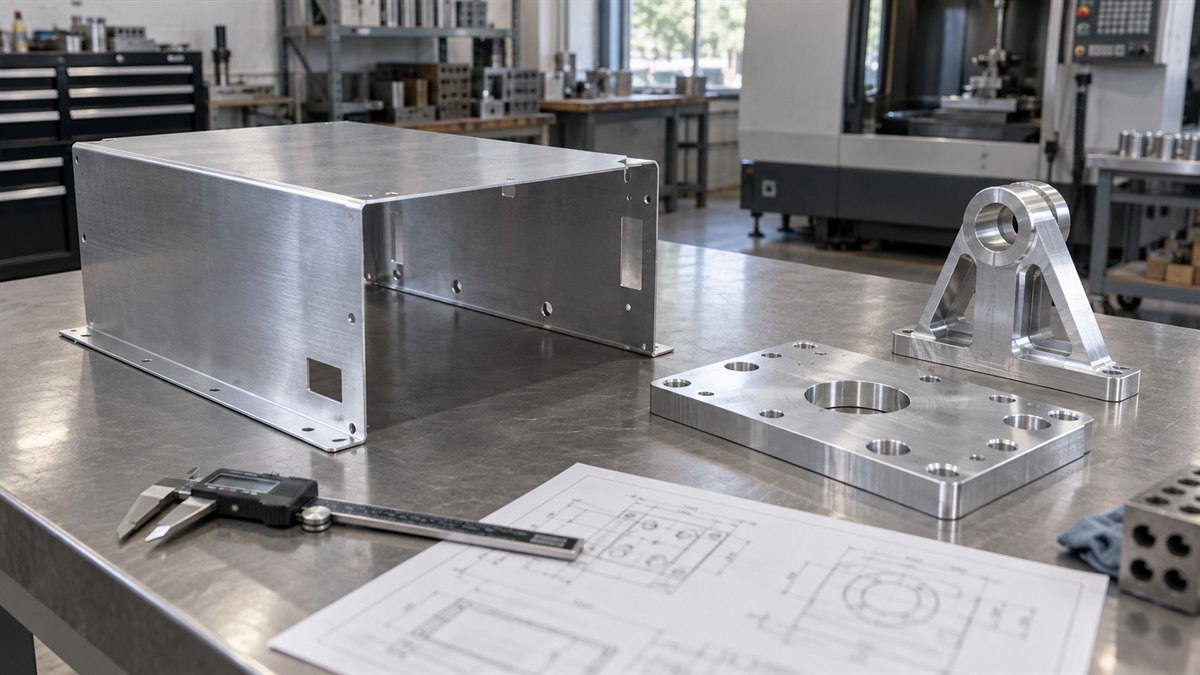
Quick answer: 6061-T6 or T651 is generally selected when higher strength, machining performance and structural rigidity are priorities. 5052-H32 is commonly preferred when the part requires tighter bending, forming, corrosion resistance and welded sheet fabrication.
The correct comparison must include the temper, product form, thickness, fabrication route and service environment. “5052 versus 6061” without these details is not a complete purchasing specification.
Google users often ask whether 5052 or 6061 aluminum is stronger. The short answer is usually 6061 in a T6-type condition, but strength alone does not determine which alloy will produce the better part. A formed tank, a bent enclosure and a CNC-machined fixture impose different requirements.
5052 is an aluminum-magnesium alloy that is strengthened by strain hardening and cannot be strengthened by heat treatment. 6061 is an aluminum-magnesium-silicon alloy that can be solution heat treated and aged. This metallurgical difference explains many of the practical differences in forming, machining and temper selection.
5052 vs 6061 at a Glance
| Selection factor | 5052 aluminum | 6061 aluminum |
|---|---|---|
| Alloy family | 5xxx aluminum-magnesium | 6xxx aluminum-magnesium-silicon |
| Strengthening route | Strain hardened; non-heat-treatable | Heat treatable; commonly supplied in T4, T6 or T651 |
| Strength direction | Moderate strength with strong sheet-forming value | T6/T651 normally provides higher strength than common 5052 sheet tempers |
| Bending and forming | Usually the better starting point for tight bends and formed sheet parts | T6 has limited formability; bend radius and orientation require review |
| Machining | Softer and more prone to gummy chips or edge buildup | Generally preferred for CNC-machined plates, brackets and fixtures |
| Typical purchasing direction | Sheet-metal fabrication, tanks, covers, panels and formed parts | Structural plate, machined components, frames, bars, tubes and profiles |
These are selection directions rather than guaranteed properties. Mechanical requirements must be checked against the governing product standard for the ordered form, temper and thickness, then confirmed by the material certificate.
Which Alloy Is Stronger?
When buyers compare common conditions such as 5052-H32 sheet and 6061-T6 plate or sheet, 6061-T6 normally provides higher yield and tensile strength. This makes it attractive for frames, supports, fixtures and machined parts where section stiffness and load capacity are important.
However, comparing only alloy numbers can produce the wrong conclusion. 6061-O, 6061-T4 and 6061-T6 have very different mechanical behavior. Likewise, 5052-O and strain-hardened 5052 tempers are not interchangeable. Thickness and product form can also change the applicable property limits.
Choose 6061 when strength supports the design
6061-T6 or T651 is a practical starting point for machined plates, automation fixtures, structural brackets, frames and components requiring a useful balance of strength, machinability and corrosion resistance. T651 plate is stress relieved by stretching and is often considered where dimensional stability during machining matters.
Choose 5052 when the manufacturing route controls
A lower nominal strength may still produce the better component when the design requires deep forming, repeated bends or a crack-resistant sheet-metal process. 5052 is widely considered for enclosures, tanks, covers, vehicle panels and corrosion-resistant fabricated sheet parts.
Bending and Forming: Why 5052 Often Wins
5052 is normally more forgiving for formed sheet components. Its non-heat-treatable alloy system and common sheet tempers support bending and fabrication routes that would be more demanding in 6061-T6.
6061 can be formed, but the temper must be selected deliberately. T4 is more formable than T6, while T6 may require a larger bend radius and careful attention to rolling direction, tooling, edge quality and thickness. If a completed 6061 component must return to a defined heat-treated condition, the processing route and final properties require engineering control.
Buyers should send a drawing showing bend radius, angle, grain direction if controlled, surface requirement and whether cracking on the outside of the bend is permitted. A supplier cannot determine formability from alloy alone.
Machining and Dimensional Stability: Why 6061 Often Wins
6061-T6 and T651 are commonly selected for CNC machining because they machine more cleanly than softer 5052 sheet and can provide higher structural strength. T651 is particularly relevant for plate when residual-stress control and dimensional stability are purchasing priorities.
For a precision part, specify more than alloy and temper. The RFQ should define plate thickness, flatness, thickness tolerance, machining allowance, sawn or milled edges, surface protection, inspection datum and whether ultrasonic testing is required. A generic “6061 plate” request does not establish these acceptance criteria.
Corrosion, Welding and Marine Exposure
Corrosion resistance
Both alloys are used where corrosion resistance matters, but 5052 is often favored for formed sheet exposed to moisture or marine atmosphere. 6061 remains useful for frames, profiles, machined hardware and selected marine components. Severe or continuously immersed seawater service should not be decided from this comparison alone; 5083, 5086 or another project-approved marine grade may be more appropriate.
Welding consequences
Both alloys can be welded with a qualified procedure, but welding 6061-T6 reduces strength in the heat-affected zone unless the design and any post-weld treatment account for it. For a welded assembly, base-metal strength alone is not the correct design value. Joint design, filler selection, service environment and post-weld acceptance requirements must be reviewed together.
Choose by Component, Not by Alloy Reputation
| Component requirement | Better starting point | What still needs confirmation |
|---|---|---|
| Bent enclosure or formed cover | 5052 sheet | Temper, bend radius, thickness, appearance and coating |
| Welded tank or fabricated sheet assembly | Often 5052; application review required | Media, pressure, welding code, filler and inspection |
| CNC-machined plate or fixture | 6061-T651 | Flatness, residual stress, allowance and tolerance |
| Structural frame or bracket | 6061-T6/T651 | Load case, weld-zone strength, section and surface protection |
| Heavy seawater-exposed structural plate | Review 5083/5086 rather than forcing a 5052/6061 choice | Marine standard, temper, class approval and corrosion testing |
For current product forms and purchasing data, review the 5052 aluminium sheet and 6061 aluminium sheet pages. The broader aluminium sheet and plate range can be used when the grade is not yet fixed.
Information Needed for an Accurate RFQ
- Alloy and complete temper, such as 5052-H32 or 6061-T651.
- Product form: sheet, plate, coil, bar, tube, profile or machined blank.
- Thickness, width, length, quantity and dimensional tolerances.
- Forming, bending, welding, machining and surface-treatment operations.
- Service environment, load, appearance and corrosion-protection requirements.
- Governing standard, MTC, traceability, inspection and packing requirements.
Frequently Asked Questions
Is 6061 always better because it is stronger?
No. Higher strength does not compensate for poor formability or an unsuitable fabrication route. A correctly formed 5052 component may be more reliable and economical than a 6061-T6 part that cracks during bending.
Can 5052 be machined?
Yes, but its softer cutting behavior is usually less convenient than 6061 for precision machining. Tooling, cutting parameters and chip control should be selected for the actual temper and part geometry.
Which alloy is better for saltwater?
5052 is often preferred over 6061 for formed sheet exposed to marine atmosphere, but continuously immersed or structural marine service may require 5083, 5086 or another specified marine grade. The final choice should follow the design code and project environment.
Choosing between 5052 and 6061?
Send the drawing, temper, dimensions, fabrication route, service environment and required certificate for material and quotation review.
Post time: Sep-16-2026