5083 Aluminum Round Bar: Temper, Standards and RFQ Guide
5083 aluminum round bar is considered when a machined or fabricated component needs a combination of useful strength, weldability and resistance to aggressive environments. The alloy number alone is not enough for purchasing. A complete order should identify the manufacturing route, governing standard, temper, diameter, length, dimensional tolerances, surface condition and inspection documents.
Quick answer: 5083 is a non-heat-treatable aluminum-magnesium alloy. ASTM B221/B221M is the relevant starting point when the bar is produced by extrusion, but buyers must confirm that the required alloy, temper, dimensions and tolerances are covered by the edition named in the purchase order. Do not specify ASTM B211/B211M automatically: that standard covers rolled or cold-finished bar, rod and wire, and its published alloy list must be checked before applying it to 5083.
What Is 5083 Aluminum Round Bar?
5083 is a wrought 5xxx-series aluminum alloy whose principal alloying addition is magnesium. It is strengthened by solid-solution effects and strain hardening rather than by precipitation heat treatment. The alloy is especially associated with marine, offshore, transport-tank and low-temperature applications.
According to Hydro, 5083 is most commonly supplied as plate and sheet but is also used for certain extrusions when its combination of strength, weldability and corrosion resistance is required. This matters when sourcing round bar: availability can be more specialized than common 6xxx-series extruded bar, so diameter, temper and quantity should be checked before a design is released.
Round Bar, Rod and Billet Are Not Automatically the Same
| Term | What it may describe | What the buyer should confirm |
|---|---|---|
| Round bar | Solid circular product supplied to a defined diameter and length | Extruded, rolled, cold-finished or machined route; diameter tolerance and straightness |
| Rod | A term used differently by standards, mills and distributors | Product definition, final dimensions and governing specification |
| Billet or forging stock | Larger semi-finished stock intended for further processing | Manufacturing route, ultrasonic or other inspection, machining allowance and final-part qualification |
A supplier cannot determine the correct acceptance criteria from the words “round rod” alone. The purchase order should control the terminology through a standard, drawing and measurable dimensions.
ASTM B221 vs ASTM B211
| Standard | Published scope | 5083 purchasing implication |
|---|---|---|
| ASTM B221/B221M | Extruded aluminum and aluminum-alloy bars, rods, wire, profiles and tubes | Use it as the starting reference for an extruded round bar, then verify the alloy-temper-size combination in the stated edition |
| ASTM B211/B211M | Rolled or cold-finished aluminum and aluminum-alloy bar, rod and wire | Do not assume it covers 5083. Check the alloy list in the current edition and select another agreed specification if necessary |
Specification warning: A product page, quotation or mill listing is not a substitute for the standard itself. The buyer and supplier should confirm the active standard edition, product form, alloy, temper and dimensional range before contract acceptance.
How to Select the Temper
5083 is not strengthened by solution heat treatment and artificial ageing in the way that 6061-T6 or 6082-T6 is. Its temper designation describes the metallurgical and mechanical condition created by annealing, strain hardening and manufacturing practice.
Buyers may encounter F, O, H111, H112 or other H-tempers in commercial descriptions, but not every designation is valid for every product form, diameter and standard. The correct approach is to state the required standard and mechanical-property basis, then ask the supplier to confirm the available temper. A plate temper should not be copied into a round-bar drawing without checking that it applies to the bar product.
Machining 5083 Round Bar
Is 5083 easy to machine?
5083 can be machined, but it is not normally selected as a free-machining alloy. Tool geometry, cutting parameters, lubrication, chip control and workholding should be matched to the supplied temper and the required finish. A production trial is appropriate where dimensional stability or surface appearance is critical.
How much machining allowance is needed?
There is no universal allowance. It depends on the starting diameter tolerance, straightness, surface condition, finished-part geometry and stock-removal sequence. State the finished diameter and minimum cleanup allowance on the inquiry so the supplier can propose suitable starting stock.
Can 5083 round bar be welded?
5083 is generally regarded as weldable, but the finished assembly must still follow the applicable fabrication code. Joint design, filler-metal selection, procedure qualification, heat input, cleaning and post-weld acceptance should be defined by the project engineer. Welding can change local properties, so base-metal values should not be treated as automatic welded-joint values.
Diameter, Length and Straightness Requirements
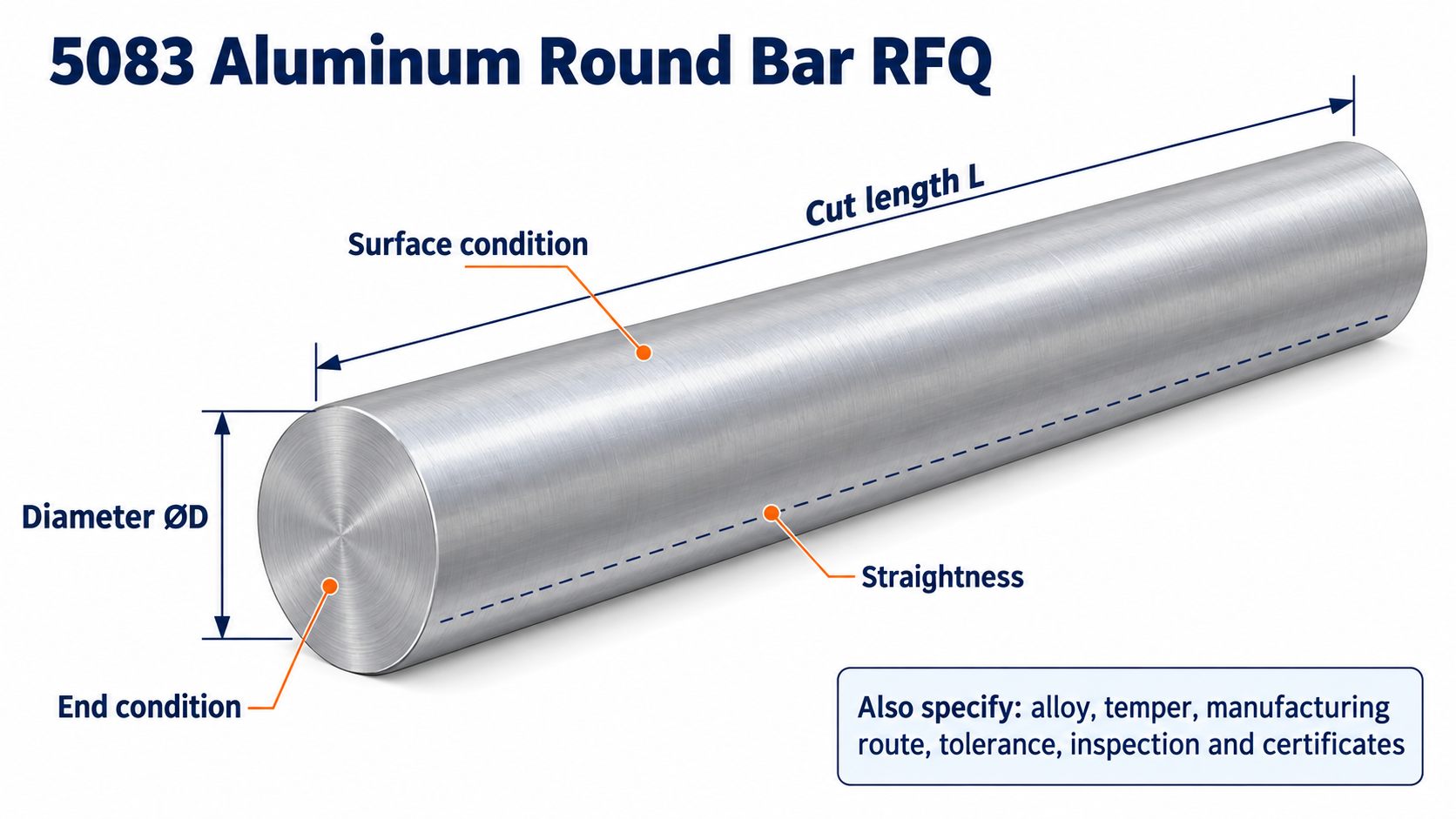
A complete dimensional request should include:
- nominal diameter and permitted diameter variation;
- cut length and length tolerance;
- straightness requirement and measurement method;
- roundness when important to machining or assembly;
- end condition, such as saw-cut, faced, chamfered or deburred;
- surface condition and permitted handling marks;
- machining allowance where the supplied surface will be removed.
If the part will be turned between centers or loaded into an automatic bar feeder, add the straightness, end preparation and stock-length requirements that control that process.
Inspection and Documents
Inspection requirements should be written into the RFQ rather than assumed. Depending on the standard and end use, buyers may request:
- material test certificate with heat or lot traceability;
- chemical-composition and tensile-property results required by the governing specification;
- diameter, roundness, length and straightness inspection;
- surface and end-condition inspection;
- ultrasonic or other nondestructive examination only when required by the drawing, code or purchase specification;
- marking, identification, packing and third-party inspection requirements.
5083 Round Bar RFQ Checklist
- Product: solid 5083 aluminum round bar
- Manufacturing route: extruded, cold-finished, rolled or another agreed route
- Standard and edition
- Required temper and mechanical-property basis
- Diameter, tolerance, roundness and straightness
- Cut length, length tolerance and end preparation
- Surface condition and machining allowance
- Quantity and unit of measure
- Service environment, welding and machining details
- Inspection, test certificate, traceability and packing requirements
Frequently Asked Questions
Is 5083 aluminum heat treatable?
No. 5083 is a non-heat-treatable alloy. Its strength comes mainly from alloying and strain hardening, not from artificial ageing.
Is ASTM B221 suitable for 5083 round bar?
ASTM B221/B221M covers extruded bars and rods and is the appropriate starting point for an extruded product. The purchase order still needs to verify that the requested 5083 temper and dimensional range are included in the specified edition.
Is ASTM B211 suitable for 5083 round bar?
Do not assume so. ASTM B211/B211M covers rolled or cold-finished bar, rod and wire, but the published alloy list in the active 2023 edition does not include 5083. Confirm an applicable specification with the producer and project engineer.
Should I choose 5083, 5086, 6061 or 6082 round bar?
Select by the finished component rather than alloy popularity. Compare required strength, corrosion exposure, welding, machining, heat-treatment condition, standard coverage and commercial availability. These alloys are not automatic substitutes, even when their sizes look identical.
Request a Specification Review
Review the 5083 aluminium round bar product page, then send the required standard, temper, diameter, length, quantity, machining plan and inspection requirements for a supply review.
Post time: Oct-19-2026