Alclad vs Bare Aluminum: What Buyers Need to Know
Alclad aluminum combines a high-strength aluminum-alloy core with thin, corrosion-resistant aluminum-alloy surface layers that are metallurgically bonded during rolling. Bare aluminum sheet has no separate cladding layer: the exposed surface is the same alloy as the core. This difference affects corrosion behavior, surface preparation, machining, inspection and the way material must be specified on an RFQ.
Quick selection rule: choose clad sheet when a specification calls for the strength of an aerospace alloy such as 2024 together with an integral sacrificial surface layer. Choose bare sheet when the design requires the base alloy at the surface, extensive machining will remove the cladding, or another controlled protection system will be applied. The drawing and governing material specification—not appearance alone—must decide the product.
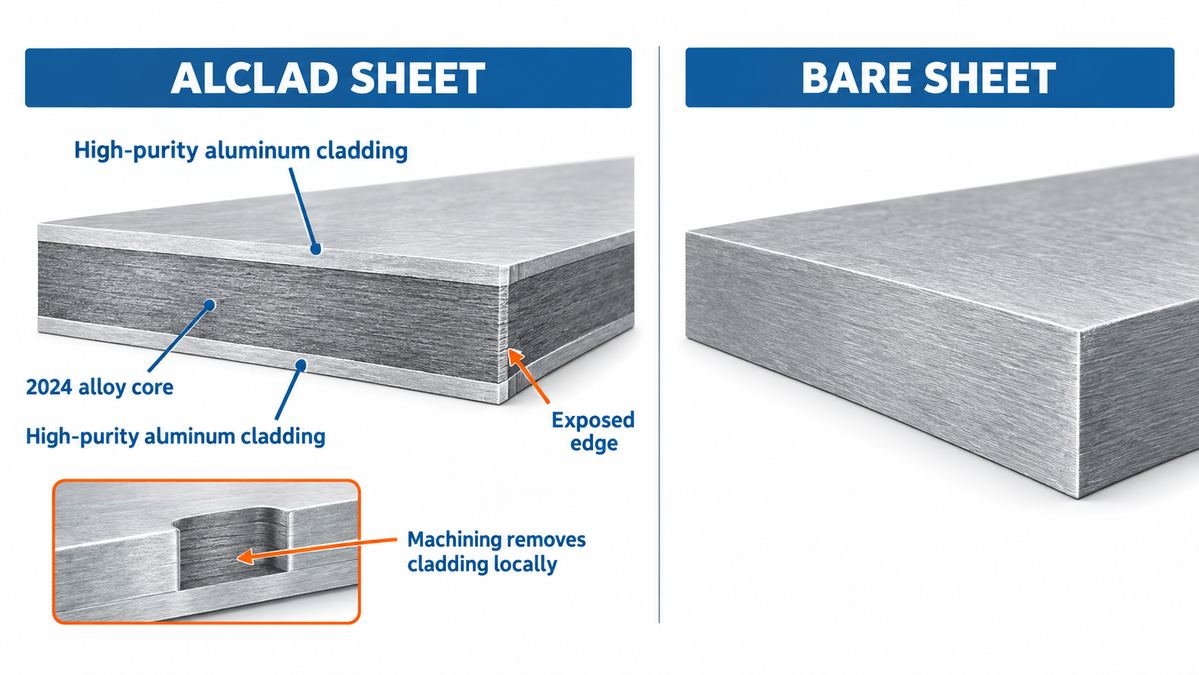
What Is Alclad Aluminum?
Alclad is a rolled composite product rather than a paint, plating or removable film. A high-strength aluminum alloy forms the structural core, while a thin layer of high-purity aluminum or another specified aluminum alloy is roll-bonded to one or both faces. The cladding is selected to be electrochemically more protective than the core and to provide a more corrosion-resistant surface.
The exact cladding alloy, whether one or both sides are clad, and the permitted cladding thickness depend on the product specification, alloy, temper and gauge. Buyers should therefore avoid treating “Alclad” as a complete material designation. The purchase order still needs the alloy, temper, form, dimensions and applicable standard.
Alclad vs Bare Aluminum at a Glance
| Decision factor | Alclad sheet | Bare sheet |
|---|---|---|
| Construction | Alloy core with bonded cladding on the specified face or faces | One homogeneous alloy through the thickness |
| Surface corrosion behavior | Cladding provides an integral protective surface while intact | Depends directly on base alloy, finish, coating and service environment |
| Machining | Machining can remove the protective layer locally | Surface remains the same alloy after machining |
| Inspection | Confirm cladding requirement, side, condition and surface damage limits | Confirm base alloy, temper, surface condition and protection system |
| Typical purchasing mistake | Ordering “Alclad” without a complete specification | Assuming all aluminum alloys have similar corrosion resistance |
Why Is 2024 Aluminum Often Supplied as Alclad?
2024 aluminum is valued for its strength, fatigue performance and machinability, but its copper-bearing composition gives it lower general corrosion resistance than many non-heat-treatable aluminum alloys. A clad product retains a 2024 structural core while adding a more corrosion-resistant surface. This is why clad 2024 sheet is widely associated with aircraft skins and other thin-gauge aerospace structures.
Cladding does not make every exposed location immune to corrosion. Sheared edges, drilled holes, countersinks, deep scratches and machined pockets can expose the core. Design details, sealants, primers, coatings, drainage and maintenance may still be required according to the service environment and approved process specification.
Review the relevant product: compare specifications, temper and available product-form information for 2024 aluminium sheet before preparing the RFQ.
How Forming and Machining Affect the Cladding
Bending and forming
Alclad sheet can be formed, but bendability is governed mainly by the core alloy, temper, thickness, bend direction, tooling and required radius. The cladding is thin and should not be used to justify a tighter bend than the base material permits. Inspect the tension surface for cracking and check whether the approved fabrication procedure restricts cladding damage.
Cutting, drilling and countersinking
Every cut edge and drilled feature exposes the core. Burr removal should be controlled so that a large surrounding area is not stripped of cladding. If the assembly requires edge sealing, primer or another protection treatment, the drawing or process specification should state it explicitly.
Surface finishing
Aggressive sanding, chemical cleaning or machining can thin or remove the cladding. Anodizing, conversion coating, adhesive bonding and painting require a process qualified for the exact clad product. Do not assume that a finish developed for bare 2024 will produce the same appearance or process response on a clad surface.
How Can You Identify Alclad Sheet?
- Check the material certificate: the alloy, temper, product form and clad/bare designation should agree with the purchase order.
- Check specification and markings: aerospace sheet markings and packaging normally identify the controlling specification and material condition.
- Review the cut edge carefully: a layer boundary may be visible under suitable preparation and magnification, but visual inspection alone is not a reliable acceptance method.
- Use an approved verification method: when identity is critical, follow the drawing, quality plan or laboratory method for cladding and core verification.
- Maintain traceability: keep heat or lot references connected to pieces after cutting and nesting.
Receiving caution: color, brightness and scratch pattern are not sufficient to prove whether a sheet is clad. Protective film may also hide the metal surface. Use purchase documents and traceable markings as the primary evidence.
Which Specifications Should Be Stated?
Bare and clad versions of the same alloy can be covered by different material specifications. For example, aerospace procurement may distinguish bare 2024 sheet under an AMS specification from clad 2024 sheet under a different AMS specification. The order should state the exact document number and revision required by the design authority rather than relying on a generic description such as “aircraft aluminum.”
Buyers can review the 2024 aluminium sheet page for available product-form information and the broader aluminium sheet and plate range when comparing alloys and forms. Final availability and compliance should be confirmed against the requested specification, temper, dimensions and certification scope.
RFQ Checklist for Clad or Bare Aluminum Sheet
- alloy designation and temper;
- clad or bare condition, including one-side cladding if applicable;
- governing material specification and revision;
- thickness, width, length and quantity;
- dimensional and flatness tolerances;
- surface finish, protective film and permitted defect limits;
- grain or rolling direction requirements on cut blanks;
- certificate, traceability and inspection-document requirements;
- planned forming, machining, bonding or finishing process;
- packaging and surface-protection requirements.
Frequently Asked Questions
Is Alclad the same as anodized aluminum?
No. Alclad is a metallurgically bonded aluminum layer applied during manufacture of the rolled product. Anodizing is an electrochemical conversion of the surface after fabrication or material production.
Is Alclad stronger than bare aluminum?
The structural strength primarily comes from the core alloy and temper. Cladding is selected mainly for surface protection. Mechanical-property and thickness requirements must be taken from the governing specification for the complete clad product.
Can Alclad be welded?
The answer depends on the core alloy, joint design and approved process. Many high-strength 2xxx-series alloys are not selected for conventional fusion-welded structures. Welding also disrupts the local cladding and heat-treated condition, so the engineering specification must control the decision.
Does a scratch make Alclad unusable?
Not automatically. Acceptance depends on scratch depth, location, remaining cladding, part function and the applicable material or workmanship limit. Do not polish away an unknown amount of cladding before the defect has been evaluated.
Request a Material Review
Send the alloy, temper, clad or bare requirement, specification, thickness, dimensions, quantity, fabrication route and certificate needs. These details allow the requested aluminum sheet to be reviewed against the correct product condition.
Post time: Oct-22-2026