Introduction
6061 aluminum and 6063 aluminum are two widely used aluminum alloys in industrial applications. Both provide excellent corrosion resistance, lightweight performance and good fabrication characteristics, but they are designed for different purposes.
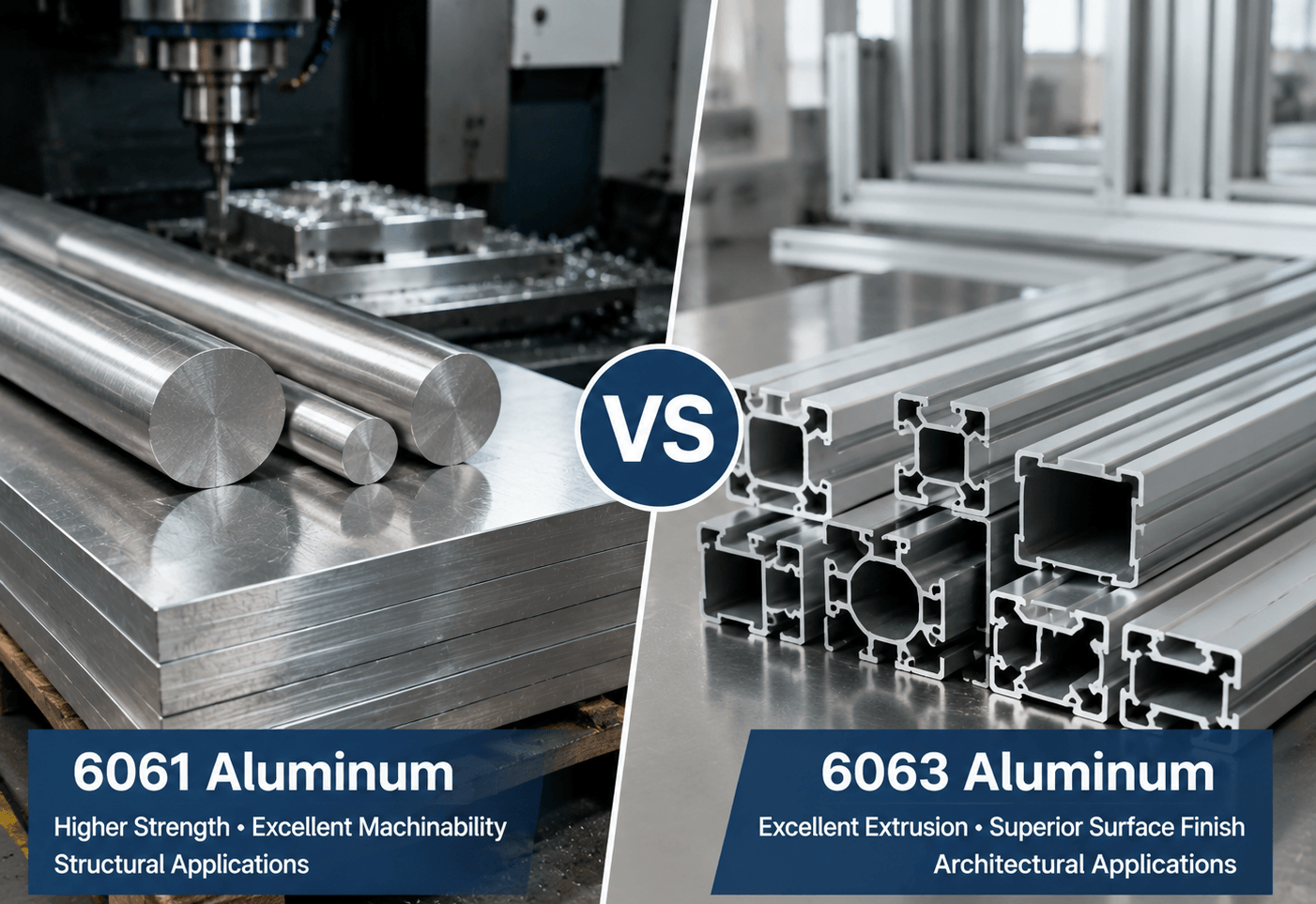
6061 aluminum is known for higher strength and excellent machinability, making it suitable for structural components, aerospace parts and machined products. 6063 aluminum is mainly used for extrusion applications because of its superior surface finish and formability.
Choosing between 6061 and 6063 aluminum depends on strength requirements, manufacturing method, surface appearance and application conditions.
Quick Answer: 6061 Aluminum vs 6063 Aluminum
- 6061 aluminum provides higher strength and better machining performance.
- 6063 aluminum provides better extrusion performance and surface finish.
- 6061 is commonly used for structural and mechanical components.
- 6063 is commonly used for architectural profiles, frames and decorative applications.
What Is 6061 Aluminum?
6061 aluminum is a precipitation-hardening aluminum alloy containing magnesium and silicon as the main alloying elements. It is one of the most commonly used aluminum alloys because it offers a balanced combination of strength, corrosion resistance and machinability.
6061 aluminum is available in various tempers, with 6061-T6 being one of the most widely used conditions due to its improved mechanical properties.
Characteristics of 6061 Aluminum
- Higher strength compared with many extrusion alloys.
- Excellent machinability.
- Good corrosion resistance.
- Suitable for welding and fabrication.
- Widely used for structural applications.
What Is 6063 Aluminum?
6063 aluminum is an aluminum-magnesium-silicon alloy mainly developed for extrusion applications. It provides excellent surface quality, good corrosion resistance and easy forming characteristics.
Because of its extrusion performance, 6063 aluminum is widely used for architectural profiles, window frames, doors, curtain walls and decorative structures.
Characteristics of 6063 Aluminum
- Excellent extrusion performance.
- Superior surface finish after anodizing.
- Good corrosion resistance.
- Easy to form into complex profiles.
- Suitable for architectural applications.
6061 vs 6063 Aluminum: Basic Comparison
| Property | 6061 Aluminum | 6063 Aluminum |
|---|---|---|
| Main Alloy Elements | Magnesium and silicon | Magnesium and silicon |
| Main Advantage | Strength and machinability | Extrusion and surface finish |
| Strength Level | Higher | Lower |
| Typical Products | Plate, bar, structural parts | Extrusions, profiles |
6061 vs 6063 Aluminum Chemical Composition Comparison
Both 6061 and 6063 aluminum belong to the 6000 series aluminum alloys and use magnesium and silicon as the primary alloying elements. However, differences in alloy composition result in different mechanical properties and manufacturing characteristics.
| Element | 6061 Aluminum | 6063 Aluminum |
|---|---|---|
| Magnesium (Mg) | Higher content, contributing to strength | Lower content, optimized for extrusion |
| Silicon (Si) | Provides precipitation hardening | Improves extrusion characteristics |
| Copper (Cu) | Contains controlled copper addition | Usually very low copper content |
| Main Design Purpose | Strength and structural performance | Extrusion and appearance quality |
6061 vs 6063 Aluminum Strength Comparison
The biggest difference between 6061 and 6063 aluminum is mechanical strength. 6061 aluminum is generally stronger because it is designed for structural applications, while 6063 aluminum prioritizes extrusion performance and surface quality.
| Property | 6061-T6 Aluminum | 6063-T6 Aluminum |
|---|---|---|
| Tensile Strength | Higher | Moderate |
| Yield Strength | Higher structural strength | Lower than 6061 |
| Hardness | Higher | Lower |
| Weight | Similar density | Similar density |
Which Is Stronger: 6061 or 6063 Aluminum?
6061 aluminum is stronger than 6063 aluminum in most temper conditions. This makes 6061 more suitable for load-bearing components, frames, machinery parts and structural applications.
6063 aluminum is selected when extrusion quality, surface appearance and complex profile shapes are more important than maximum strength.
Machining and Extrusion Performance Comparison
Manufacturing method is one of the key factors when selecting between 6061 and 6063 aluminum. Their different alloy characteristics make them suitable for different production processes.
| Manufacturing Process | 6061 Aluminum | 6063 Aluminum |
|---|---|---|
| Machining | Excellent machining performance | Suitable but less commonly selected |
| Extrusion | Good extrusion capability | Excellent extrusion performance |
| Complex Profiles | Suitable for simple profiles | Excellent for complex shapes |
| Welding | Good weldability | Good weldability |
Surface Finish and Corrosion Resistance
Both 6061 and 6063 aluminum provide good corrosion resistance because they form a protective oxide layer. However, 6063 aluminum is often preferred for visible architectural applications because it produces an excellent surface finish after extrusion and anodizing.
| Feature | 6061 Aluminum | 6063 Aluminum |
|---|---|---|
| Anodizing Performance | Good | Excellent |
| Surface Appearance | Good | Superior |
| Corrosion Resistance | Excellent | Excellent |
Industrial Application Selection Guide
| Application | Recommended Alloy | Reason |
|---|---|---|
| Structural Frames | 6061 | Higher strength and load capacity |
| CNC Machined Parts | 6061 | Better machining performance |
| Window and Door Profiles | 6063 | Excellent extrusion and appearance |
| Architectural Extrusions | 6063 | Better surface finish after anodizing |
6061 and 6063 Aluminum Standards and Tempers
6061 and 6063 aluminum products are commonly supplied according to international standards that define chemical composition, mechanical properties, dimensions and heat treatment conditions.
| Standard | Description |
|---|---|
| ASTM B209 | Aluminum and aluminum alloy sheet and plate products |
| ASTM B221 | Aluminum and aluminum alloy extruded bars, rods, wire, profiles and tubes |
| EN 573 | Chemical composition designation of wrought aluminum alloys |
| EN 755 | Extruded aluminum alloy products with mechanical requirements |
Common Aluminum Tempers
The temper condition affects the final strength, hardness and fabrication performance of aluminum alloys. The same alloy can provide different properties depending on heat treatment and processing conditions.
| Temper | Characteristics | Common Applications |
|---|---|---|
| T5 | Artificial aging after extrusion | Aluminum profiles and extrusions |
| T6 | Solution heat treated and artificially aged | Structural and mechanical components |
| O Temper | Annealed condition with improved formability | Forming and fabrication applications |
How Industrial Buyers Select Between 6061 and 6063 Aluminum
For industrial buyers, the correct aluminum alloy selection should consider the complete application requirement instead of focusing only on material price.
| Requirement | Recommended Alloy | Reason |
|---|---|---|
| High load-bearing capacity | 6061 Aluminum | Higher strength and rigidity |
| Complex extrusion profiles | 6063 Aluminum | Better extrusion performance |
| Visible architectural surfaces | 6063 Aluminum | Superior surface finish |
| CNC machining projects | 6061 Aluminum | Better machining characteristics |
FAQ
What is the main difference between 6061 and 6063 aluminum?
The main difference is application focus. 6061 aluminum is designed for higher strength and machining performance, while 6063 aluminum is optimized for extrusion quality and surface finish.
Is 6061 aluminum stronger than 6063 aluminum?
Yes. 6061 aluminum generally provides higher tensile strength and yield strength, making it more suitable for structural applications.
Why is 6063 aluminum used for extrusion?
6063 aluminum has excellent extrusion characteristics, allowing manufacturers to produce complex profiles with smooth surfaces and good dimensional accuracy.
Which aluminum alloy is better for CNC machining?
6061 aluminum is commonly selected for CNC machining because it provides good machinability, strength and dimensional stability.
Can 6063 aluminum be used for structural applications?
Yes, 6063 aluminum can be used for some structural applications, especially where extrusion performance and appearance are important. However, 6061 is usually preferred for higher mechanical loads.
Aluminum Alloy Solutions from SASA Aluminum
SASA Aluminum supplies 6000 series aluminum materials including 6061 and 6063 aluminum products for industrial, construction, transportation and customized manufacturing applications.
Available products include aluminum plates, sheets, bars and extruded profiles with customized dimensions and material documentation according to project requirements.
Technical support is available for alloy selection, temper selection, processing requirements and application evaluation.
For aluminum material requirements, please provide alloy grade, temper, dimensions, quantity and application details.
Conclusion
6061 and 6063 aluminum are both important 6000 series aluminum alloys, but they serve different industrial purposes.
6061 aluminum is the better choice when strength, machining and structural performance are required. 6063 aluminum is preferred when extrusion quality, appearance and complex profiles are the main considerations.
Understanding the differences between 6061 and 6063 aluminum helps industrial buyers select the right material for improved performance, manufacturing efficiency and long-term reliability.
Post time: Jul-25-2026