Introduction
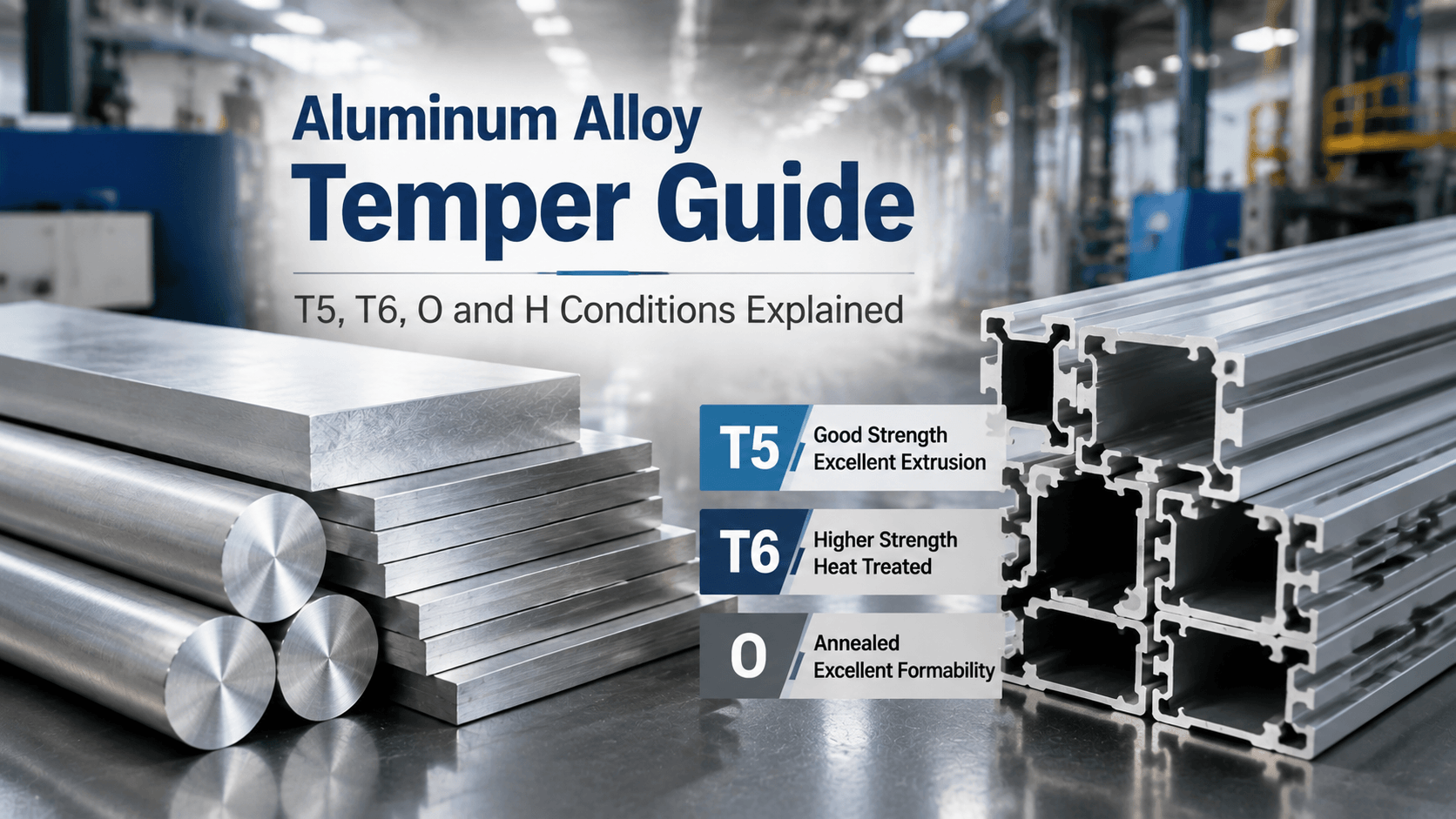
Aluminum alloy temper is an important designation that describes the condition of aluminum after processing, including heat treatment, cold working and aging. The temper condition directly affects mechanical properties such as strength, hardness, ductility and formability.
When purchasing aluminum products, specifying only the alloy grade is usually not enough. For example, 6061-T6 and 6061-O are both aluminum 6061 alloys, but they have significantly different mechanical properties and applications.
Understanding aluminum temper designations helps engineers and buyers select the correct material condition according to strength requirements, fabrication methods and final service conditions.
Quick Answer: What Is Aluminum Temper?
- Aluminum temper describes the processing condition of an aluminum alloy after manufacturing.
- T temper indicates heat-treated conditions, such as T5 and T6.
- O temper indicates annealed aluminum with improved formability.
- H temper indicates strain-hardened aluminum, commonly used for non-heat-treatable alloys.
Understanding Aluminum Alloy Temper Designation
An aluminum alloy designation normally consists of two parts: the alloy number and the temper designation.
For example:
| Example | Meaning |
|---|---|
| 6061-T6 | 6061 aluminum alloy in solution heat-treated and artificially aged condition |
| 6063-T5 | 6063 aluminum alloy cooled from extrusion process and artificially aged |
| 5052-H32 | 5052 aluminum alloy strain hardened and stabilized |
The alloy number identifies the chemical composition, while the temper designation identifies the manufacturing and heat treatment condition.
Common Aluminum Temper Designations
Aluminum temper symbols are internationally recognized and help buyers understand how aluminum properties have been achieved.
| Symbol | Meaning | Typical Characteristics |
|---|---|---|
| F | As fabricated | No special control over thermal or mechanical treatment |
| O | Annealed condition | Soft condition with excellent formability |
| H | Strain hardened | Strength increased through cold working |
| T | Heat treated condition | Strength improved through heat treatment and aging |
T Temper Aluminum: T5 vs T6
T temper conditions are widely used for heat-treatable aluminum alloys such as 6061 and 6063. The difference between T5 and T6 is mainly related to the heat treatment process.
Aluminum T5 Temper
T5 aluminum is cooled from an elevated temperature shaping process and then artificially aged to improve strength and stability.
This temper is commonly used for extruded aluminum profiles because it provides a good balance between strength, dimensional stability and extrusion performance.
- Commonly used with 6063 aluminum
- Excellent extrusion performance
- Good surface appearance
- Suitable for architectural profiles
Aluminum T6 Temper
T6 aluminum is solution heat treated and artificially aged to achieve higher mechanical strength.
It is commonly selected when structural performance and load-bearing capability are important.
- Commonly used with 6061 aluminum
- Higher strength compared with many T5 conditions
- Suitable for structural components
- Good machining performance
T5 vs T6 Aluminum Temper Comparison
T5 and T6 are two of the most common aluminum temper conditions used in industrial applications. Although both improve aluminum performance through aging treatment, their manufacturing processes and final properties are different.
| Feature | T5 Temper | T6 Temper |
|---|---|---|
| Treatment Method | Cooled from elevated temperature shaping process and artificially aged | Solution heat treated and artificially aged |
| Strength | Medium to high strength | Higher strength condition |
| Extrusion Performance | Excellent | Good |
| Surface Finish | Excellent for extrusion profiles | Good |
| Typical Alloy | 6063-T5 | 6061-T6 |
O Temper Aluminum: Annealed Condition
O temper indicates that aluminum has been annealed to achieve a soft condition. During annealing, internal stresses are reduced and the material becomes easier to form and process.
Compared with heat-treated tempers such as T5 and T6, O temper aluminum usually has lower strength but significantly improved ductility and formability.
| Characteristic | O Temper Aluminum |
|---|---|
| Strength | Lower compared with hardened tempers |
| Formability | Excellent |
| Bending Performance | Suitable for complex forming operations |
| Typical Applications | Deep drawing, forming and fabrication |
H Temper Aluminum: Strain Hardened Condition
H temper is mainly used for non-heat-treatable aluminum alloys. The material strength is increased through cold working, such as rolling or stretching.
The H designation is commonly followed by additional numbers that describe the degree of strain hardening and stabilization.
| Temper | Meaning | Typical Application |
|---|---|---|
| H32 | Strain hardened and stabilized | Sheet metal fabrication |
| H34 | Higher degree of strain hardening | Industrial panels and structural sheets |
How Temper Affects Aluminum Properties
The selected temper condition has a direct influence on aluminum performance. Buyers should consider the balance between strength, formability and manufacturing requirements.
| Property | Temper Influence |
|---|---|
| Strength | T and H tempers generally provide higher strength |
| Hardness | Usually increases with aging or cold working |
| Formability | O temper generally provides the highest formability |
| Machining | Depends on alloy and temper condition |
| Welding Behavior | May vary after welding depending on alloy and heat treatment |
Temper Selection Guide for Industrial Buyers
| Requirement | Recommended Temper Consideration |
|---|---|
| High strength structural parts | T6 temper such as 6061-T6 |
| Extruded aluminum profiles | T5 temper such as 6063-T5 |
| Deep forming or bending | O temper |
| Sheet applications requiring cold work strength | H temper |
Applications of Different Aluminum Tempers
Different aluminum temper conditions are selected according to application requirements. Strength, formability, extrusion performance and fabrication methods all influence the final material choice.
| Temper | Typical Aluminum Grades | Common Applications |
|---|---|---|
| T6 | 6061-T6, 7075-T6 | Structural parts, machinery components, aerospace applications |
| T5 | 6063-T5 | Aluminum profiles, architectural frames, extrusion products |
| O | 5052-O, 3003-O | Deep drawing, bending and forming applications |
| H32 / H34 | 5052-H32, 5083-H32 | Marine panels, industrial sheets and fabricated structures |
Common Standards for Aluminum Temper Designation
Aluminum temper designations are defined through internationally recognized standards that specify alloy conditions, mechanical properties and product requirements.
| Standard | Description | Application |
|---|---|---|
| ASTM B209 | Aluminum and aluminum alloy sheet and plate requirements | Aluminum sheet and plate products |
| ASTM B221 | Aluminum extrusion products requirements | Profiles, bars, rods and tubes |
| ASTM B211 | Aluminum alloy bars, rods and wires | Industrial aluminum products |
| ANSI H35.1 | Aluminum alloy and temper designation system | Defines aluminum temper symbols |
FAQ
What does T6 mean in aluminum?
T6 indicates that aluminum has been solution heat treated and artificially aged. This condition provides increased strength and hardness compared with softer tempers.
Is T6 aluminum stronger than T5 aluminum?
Generally, T6 aluminum provides higher mechanical strength than T5 aluminum. However, T5 aluminum often provides better extrusion performance and surface quality.
What is O temper aluminum?
O temper aluminum is an annealed condition with reduced hardness and improved ductility. It is commonly selected for forming and bending applications.
What is the difference between aluminum alloy and aluminum temper?
The alloy designation identifies the chemical composition, while the temper designation identifies the processing condition that determines mechanical properties.
Can the same aluminum alloy have different tempers?
Yes. The same aluminum alloy can be supplied in different temper conditions. For example, 6061 aluminum is available as 6061-O, 6061-T4 and 6061-T6, each with different properties.
How should buyers specify aluminum temper?
Buyers should specify alloy grade, temper condition, product form, dimensions, required standards and application requirements when requesting aluminum products.
Related Aluminum Products
Aluminum alloys with different temper conditions are available in various product forms for industrial applications.
- 6061-T6 Aluminum Plate
- 6061-T6 Aluminum Bar
- 6063-T5 Aluminum Profiles
- 5052-H32 Aluminum Sheet
- 5083-H32 Aluminum Plate
- Customized Aluminum Components
When requesting a quotation, customers should provide alloy grade, temper condition, dimensions, quantity and application information to ensure the correct material selection.
Conclusion
Aluminum temper is an essential factor that determines the final performance of aluminum products. Different temper conditions provide different balances between strength, hardness, ductility and fabrication capability.
T6 is commonly selected for high-strength structural applications, T5 is widely used for extrusion profiles, O temper is preferred for forming operations, and H temper is commonly used for strain-hardened sheet products.
For industrial buyers, selecting the correct aluminum temper together with the alloy grade ensures that the material meets both manufacturing requirements and service performance expectations.
Post time: Jul-30-2026