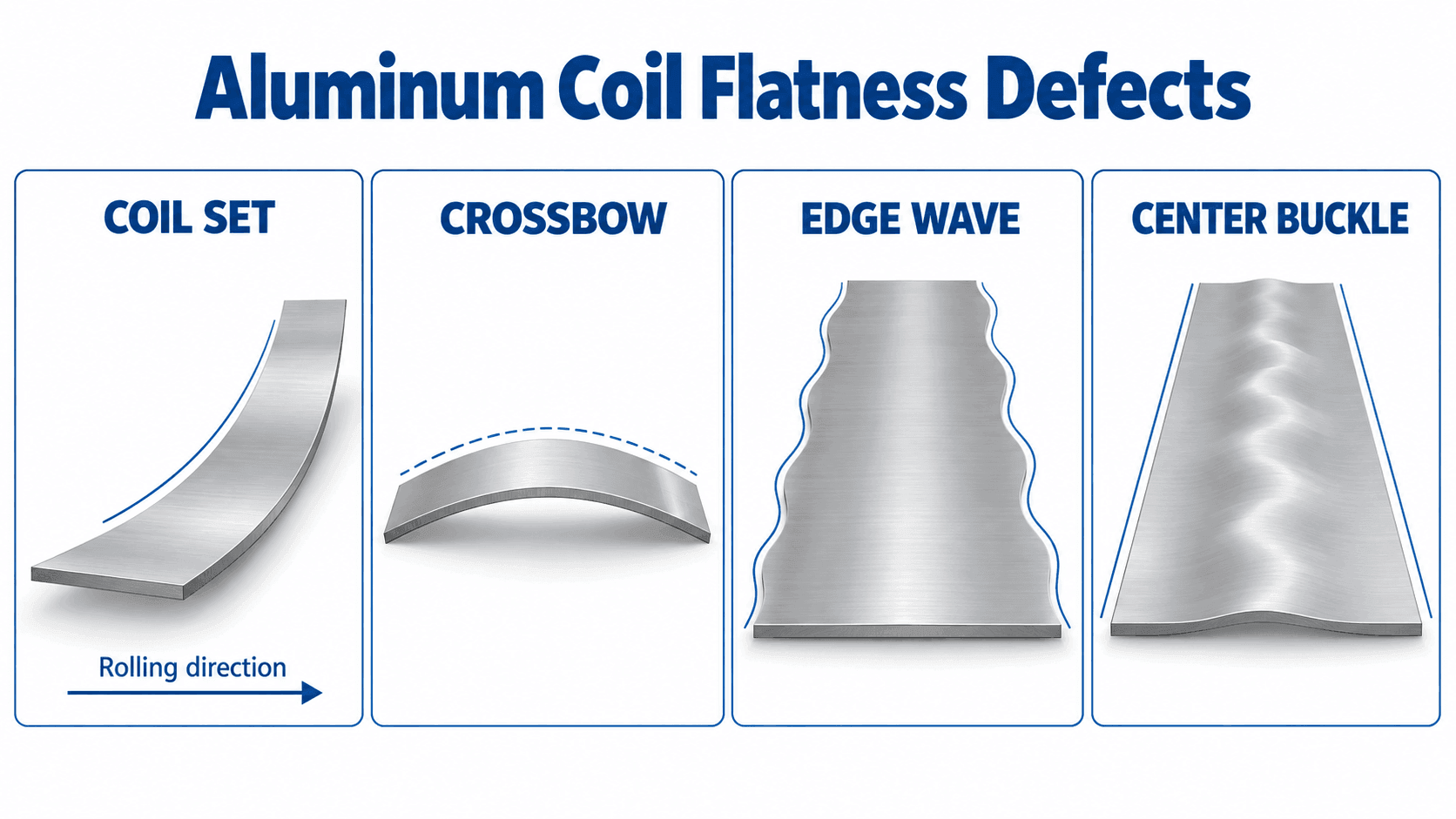
Flatness problems in aluminum coil are not all the same. A strip that curves in the rolling direction may have coil set; curvature across the width is usually described as crossbow; waves along the edges indicate edge wave; and waves concentrated near the center indicate center buckle. Correctly naming the condition helps buyers, processors and suppliers discuss inspection results without confusing flatness, camber and surface appearance.
What Is an Aluminum Coil Flatness Defect?
In practical coil processing, flatness describes whether the unrestrained material lies in the intended plane. A visible wave or curvature indicates that different parts of the strip are not behaving as though they have the same effective length or residual stress state. The pattern may come from upstream rolling, thermal history, slitting, winding, handling or a combination of factors.
It is important to separate three observations:
- Flatness or shape: out-of-plane curvature or waviness.
- Camber or side bow: lateral deviation of the strip edge or centerline in the plane of the sheet.
- Surface defects: scratches, dents, stains, roll marks or oxidation affecting appearance or surface condition.
One coil can show more than one condition. For example, a strip may retain longitudinal coil set while also showing localized edge wave. Record each observation separately.
Coil Set vs Crossbow vs Edge Wave vs Center Buckle
| Condition | Typical appearance | Direction or location | Useful inspection note |
|---|---|---|---|
| Coil set | The uncoiled strip retains a smooth curve instead of lying flat. | Curvature runs along the strip length or rolling direction. | Observe a defined free length after uncoiling and state whether the sample is restrained. |
| Crossbow | The strip curves from one edge to the other across its width. | Curvature is transverse to the rolling direction. | Use a defined width section and agreed reference surface; do not confuse it with longitudinal coil set. |
| Edge wave | One or both edges rise and fall while the center is comparatively flat. | Waviness is concentrated near the longitudinal edges. | Record whether the wave is on one edge or both and where it occurs within the coil. |
| Center buckle | The center region rises or forms repeated waves while the edges are comparatively flat. | Waviness is concentrated around the strip centerline. | Record wavelength, height and location using the agreed method; avoid judging severity from angle-dependent photos alone. |
Is center buckle the opposite of edge wave?
They are opposite-looking manifestations of unequal length across the strip width. With edge wave, the edge regions behave as though they are longer than the center. With center buckle, the center behaves as though it is longer than the edges. This description helps identify the pattern, but it does not by itself prove which mill or processing variable caused it.
What Can Cause Aluminum Coil Flatness Problems?
Flatness defects are often associated with nonuniform elongation or residual stress across the strip. During an investigation, relevant factors may include:
- thickness profile or crown variation across the width;
- rolling load, roll deflection or thermal distribution;
- unequal tension during processing, recoiling or unwinding;
- slitting setup and stress redistribution after the strip is divided;
- coil diameter, winding condition and storage history;
- leveler settings that do not match the alloy, temper, thickness or width;
- handling or support conditions that distort a thin, flexible sample during inspection.
Why Flatness Matters in Fabrication
Even when alloy, temper and thickness are correct, unstable strip shape can interfere with downstream operations. Depending on the process, it may affect:
- consistent feeding into presses, roll formers and cutting lines;
- laser or router focal distance and nesting stability;
- registration during printing, coating, laminating or bonding;
- dimensional control after blanking, stamping or forming;
- fit-up, fixturing and cosmetic appearance in assembled parts.
The practical limit therefore depends on both the governing material specification and the buyer’s end-use process. A coil suitable for one operation may require additional leveling or tighter purchase controls for another.
How to Inspect Aluminum Coil Flatness
A repeatable inspection record is more useful than a close-up photograph. Before measuring, agree on the sample condition and method.
- Identify the material. Record alloy, temper, thickness, width, coil number and sample position.
- Define the sample state. State whether the strip is still under line tension, newly uncoiled, cut to length or allowed to relax.
- Use an agreed support. Specify the reference table or support arrangement and whether gravity influences the reading.
- Name the direction. Mark rolling direction and distinguish longitudinal curvature from transverse curvature.
- Measure a defined area. Record the evaluated length and width, maximum deviation, wave height and wavelength where applicable.
- Map the location. Note drive side/operator side, edge/center and distance from the head or tail of the coil.
- Compare with the correct requirement. Use the product form, dimensional range, edition and purchase specification named in the order.
For a supplier review, include an overall image showing sample support, a side or end view showing the deviation, a scale in the same plane and the measured values. Do not use image perspective as the measurement.
Which Flatness Tolerance Applies?
There is no single numeric flatness tolerance that applies to every aluminum coil. ASTM B209/B209M covers aluminum and aluminum-alloy flat sheet, coiled sheet and plate, while ANSI H35.2 and ANSI H35.2M provide dimensional tolerances for aluminum mill products in inch and metric formats. The applicable limit depends on the ordered product form, alloy, temper, dimensions, referenced edition and any supplementary agreement.
Do not copy a plate flatness value into a coil or strip purchase order without checking scope. Likewise, a buyer’s end-use requirement may be more specific than a general mill-product tolerance. The purchase order should state the governing document and measurement method rather than only saying “must be flat.”
Can Leveling Remove Coil Set, Edge Wave or Center Buckle?
Precision leveling can reduce certain coil shape defects by repeatedly bending the strip and redistributing residual stresses. However, the achievable result depends on the defect pattern, alloy, temper, thickness, width, equipment capability and process setup. Leveling should therefore be treated as a controlled processing step followed by inspection—not as a guarantee that every defect can be removed.
If flatness is critical, discuss the incoming condition and the required final state before ordering. For sourcing options, see our aluminum coil and aluminum strip product pages.
RFQ and Purchase Order Checklist
| Item to specify | Why it matters |
|---|---|
| Alloy and temper | Mechanical response and leveling behavior vary with condition. |
| Thickness, width, coil ID and coil weight | Defines the supplied geometry and handling range. |
| Applicable standard and edition | Prevents the use of a tolerance table for the wrong product form. |
| Defect type and acceptance limit | Separates coil set, crossbow, edge wave, center buckle and camber. |
| Inspection method and sample condition | Makes supplier and buyer readings comparable. |
| Downstream operation | Helps relate shape requirements to feeding, forming, coating or assembly. |
| Required reports or sample approval | Establishes what evidence must accompany shipment. |
Frequently Asked Questions
What is coil set in aluminum?
Coil set is the longitudinal curvature that remains after coiled aluminum is unwound. The strip retains a tendency to follow the coil radius instead of lying flat in its free state.
What is the difference between coil set and crossbow?
Coil set curves along the strip length. Crossbow curves across the strip width. Marking the rolling direction on the sample makes the distinction clearer.
What causes edge wave in aluminum coil?
Edge wave indicates unequal effective length or stress across the width, with one or both edges behaving as though they are longer than the center. Rolling profile, thermal distribution, tension, slitting and leveling conditions are possible investigation areas; the visible wave alone does not prove one cause.
How should flatness be measured?
Use the method required by the applicable specification or purchase agreement. Define the sample length, support condition, measurement direction, reference surface, location and reported deviation so that the result can be reproduced.
Can a roller leveler remove center buckle?
A suitable leveling process may reduce center buckle and other shape defects, but the result depends on the material and equipment. The leveled strip should be inspected against the agreed final requirement.
What flatness tolerance should I put on an RFQ?
Start with the standard and product form applicable to the ordered material, then add any end-use-specific limit and measurement method. Avoid using an unspecified “perfectly flat” requirement or transferring a plate value to coiled sheet without checking scope.
Need Aluminum Coil for a Flatness-Sensitive Application?
Send the alloy, temper, thickness, width, coil size, downstream process, applicable standard and flatness inspection requirement. Clear technical information helps us review the request accurately.
Post time: Oct-13-2026