Aluminum Disc Temper O vs H12 vs H14: Formability and Selection Guide
Quick answer: O temper is the usual starting point for severe forming because it offers the highest ductility of the three. H12 provides a middle ground for moderate forming, while H14 offers higher strength and stiffness but normally allows less severe deformation and produces more springback. The correct choice still depends on the alloy, thickness, part geometry, tooling, lubrication and approved forming trial.
An aluminum circle or disc may look simple, but its temper can determine whether a formed part draws cleanly, springs back out of tolerance or tears near a radius. This is why a purchasing specification should never state only “aluminum disc.” The alloy, temper, dimensions, edge condition and forming route must work together.
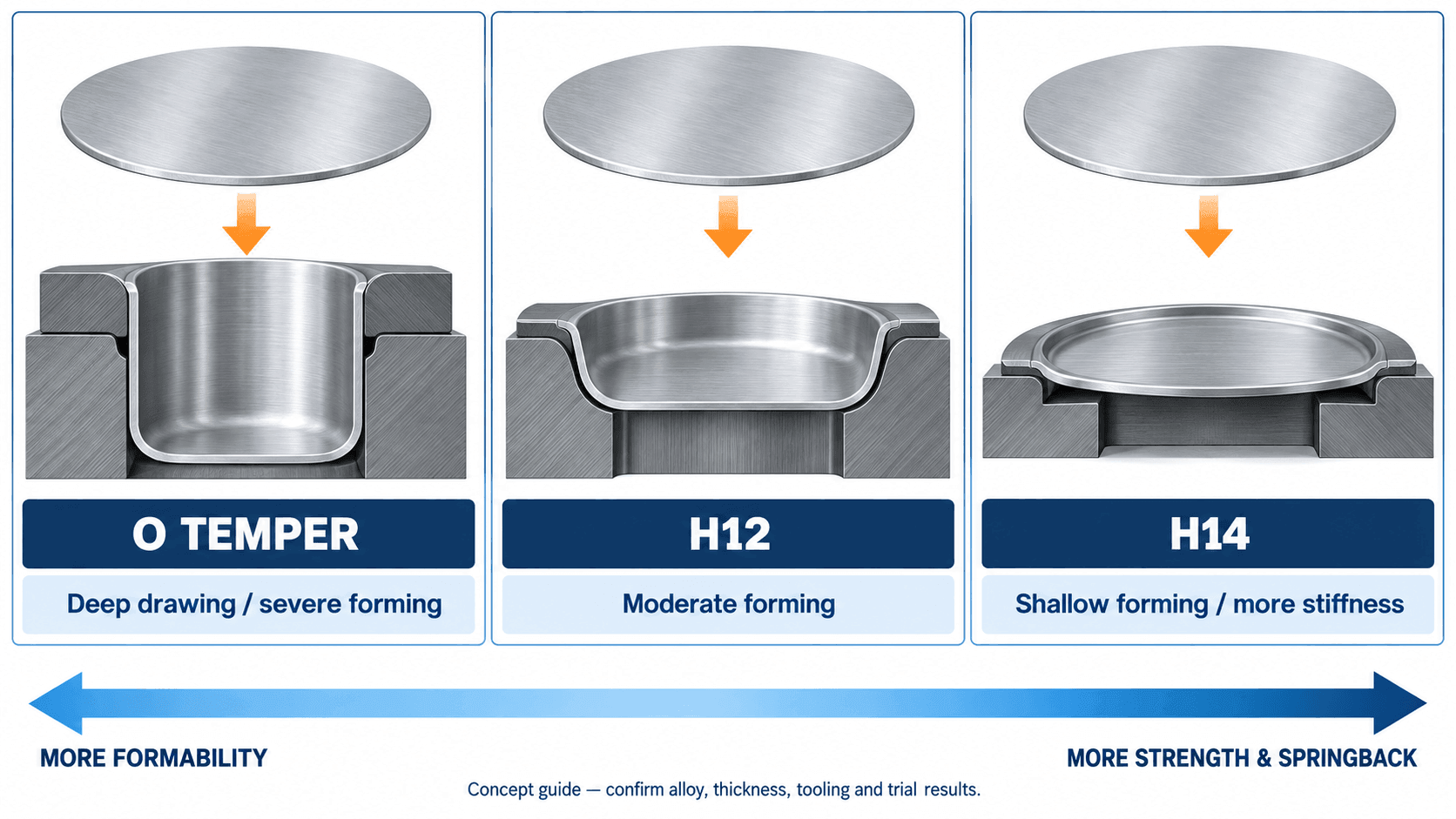
What Do O, H12 and H14 Mean?
Temper describes the processing condition of a wrought aluminum product. It is not an alloy grade and it does not identify chemistry. Under the aluminum temper designation system, O identifies annealed material. H identifies strain-hardened material; in H12 and H14, the first digit “1” means strain hardened only, and the second digit indicates the degree of strain hardening.
| Temper | Processing condition | General behavior | Typical selection direction |
|---|---|---|---|
| O | Annealed | Lowest strength and highest ductility among these three conditions | Deep drawing, severe forming or complex shapes |
| H12 | Strain hardened, quarter-hard designation | More strength than O, with useful forming capacity | Moderate drawing, spinning or formed parts needing added rigidity |
| H14 | Strain hardened, half-hard designation | Higher strength and springback, with lower forming latitude | Shallow stamping, lids, trays or flatter parts requiring stiffness |
Important: “quarter-hard” and “half-hard” are designation terms tied to the strength relationship within an alloy’s temper series. They should not be read as universal hardness percentages, and they do not produce the same numerical properties in every alloy or thickness.
How Temper Changes Forming Performance
1. Formability and Risk of Splitting
Deep drawing forces material to flow from the flange into the die cavity. A softer condition generally gives a wider process window for this plastic deformation. As strain hardening increases from O to H12 to H14, the disc normally becomes less tolerant of a severe draw, a small corner radius or uneven material flow. Edge quality also matters: burrs, notches and rough blanked edges can become crack initiation sites.
2. Strength and Part Rigidity
O temper may form easily, but a thin finished component can require additional work hardening during forming, geometry such as beads or ribs, or a different starting temper to meet rigidity requirements. H12 and H14 can provide more initial strength, but the forming operation must stay within the material’s available ductility.
3. Springback and Dimensional Control
After the load is removed, elastic recovery changes the angle or profile of the part. Higher-strength tempers commonly show more springback, so tooling compensation and process consistency become more important for H14 than for O. Springback is also affected by thickness, bend radius, forming method, friction and part geometry; it cannot be predicted from temper alone.
4. Earing and Directional Behavior
Deep-drawn cups can develop an uneven rim known as earing. This behavior is related to crystallographic texture and planar anisotropy developed during rolling and annealing. Changing from H14 to O does not automatically eliminate earing. For critical deep-drawn parts, buyers should discuss earing limits, rolling direction, blank layout and trial results with the processor.
O vs H12 vs H14: Which Should You Choose?
| Part/process question | Likely starting direction | What must be verified |
|---|---|---|
| Tall cup, narrow radius or high draw ratio | O temper is often the first candidate | Alloy, draw ratio, redraw steps, lubrication, edge quality and earing |
| Moderate-depth pan, spun shell or formed cover | H12 may balance formability and rigidity | Forming passes, tooling radii, local thinning and final dimensional tolerance |
| Shallow tray, lid or lightly formed component | H14 may provide useful stiffness | Springback, corner radius, flatness and risk of edge cracking |
| Visible or anodized surface | Temper alone is not enough | Alloy response, surface finish, scratches, grain appearance and cosmetic sample |
These are screening directions, not universal approvals. Two discs with the same temper designation can behave differently if their alloy, thickness, mechanical-property range, surface condition or production route differs. A forming trial using production-intent tooling is the most reliable confirmation for a critical part.
Do Not Choose Temper Before Choosing the Alloy
Commercially pure 1xxx-series aluminum and 3003 are commonly considered for discs because they can offer useful forming characteristics, but they are not interchangeable. Alloy chemistry affects strength, work hardening, corrosion behavior, finishing response and forming limits. The same “H14” suffix does not mean that 1050-H14, 1100-H14 and 3003-H14 have identical properties.
Use the governing material specification and the ordered thickness to determine the required mechanical-property limits. ASTM B209/B209M covers flat sheet, coiled sheet and plate in listed alloys and tempers; a disc blank is typically produced from such flat-rolled material, but the purchase order should separately define the blank geometry, edge and finished-disc acceptance requirements.
RFQ Checklist for Aluminum Circles and Discs
For a useful quotation and a material that can be validated at incoming inspection, specify:
- Alloy and temper: for example, 1050-O or 3003-H14—not “soft aluminum” alone.
- Applicable standard: state the required material standard and revision where contractually necessary.
- Thickness and tolerance: include units and any tighter-than-standard requirement.
- Disc diameter and tolerance: include roundness or concentricity requirements if they affect tooling.
- Edge condition: blanked, deburred or another agreed condition; identify whether burr direction matters.
- Surface requirements: mill finish, bright finish, protective film, scratch limits or cosmetic sample.
- End use and forming route: deep drawing, spinning, stamping or another process, including the most severe feature.
- Acceptance evidence: required material certificate, mechanical-property reporting and any approved first-article trial.
- Packing: interleaving, moisture protection and pallet limits where surface quality is critical.
See the SASA Aluminum aluminium circle product page for the available product category, then confirm the exact alloy, temper, dimensional range and acceptance criteria for your order.
Common Buying Mistakes
- Ordering by temper only. Temper modifies an alloy’s condition; it does not replace the alloy designation.
- Assuming O is always best. Maximum formability may not provide the stiffness or handling behavior required in the final part.
- Using a generic strength value. Property limits depend on alloy, temper, product form, thickness and specification.
- Ignoring edges and surface condition. A suitable temper cannot compensate for severe burrs, scratches or poor blank quality.
- Skipping a production-intent trial. Tooling, lubrication and geometry can shift the result even when the certificate is correct.
Frequently Asked Questions
What is O temper aluminum?
O temper identifies annealed wrought aluminum. It generally provides lower strength and higher ductility than strain-hardened H tempers of the same alloy, which is why it is often considered for severe forming.
Is H14 harder than H12?
Within the same alloy and applicable product range, H14 represents a greater degree of strain hardening than H12. It therefore normally has higher strength and lower formability. Compare actual specification limits rather than treating the designation as a universal hardness number.
Which aluminum disc temper is best for deep drawing?
O temper is commonly the first candidate for a severe deep draw, but the answer also depends on alloy, thickness, blank diameter, draw ratio, tool radius, lubrication, edge condition and required final properties. Validate the full process, not only the temper.
Can H14 aluminum be deep drawn?
Some H14 material can be formed into shallow or moderately shaped parts, but it normally offers less forming latitude than O or H12. Whether it can meet a particular draw depends on the exact material and tool design, so a part trial is required.
Does a harder temper reduce springback?
No. Higher-strength material commonly produces more elastic recovery after unloading. Tool compensation, process control and measurement after release from the tool are therefore important.
Technical References
- The Aluminum Association — Standards and alloy/temper designation systems
- The Aluminum Association — ANSI H35.1/H35.1M alloy and temper designation standard
- ASTM International — ASTM B209/B209M, Aluminum and Aluminum-Alloy Sheet and Plate
- Constellium — Formability, properties and springback in closure-sheet development
Preparing an aluminum disc RFQ?
Send the alloy, temper, thickness, diameter, tolerances, edge condition, surface requirement and forming application through the SASA Aluminum contact page. Final material selection should be confirmed against the governing specification and production trial.
Post time: Oct-15-2026