Aluminum Foil Dyne Level: How to Specify and Test Surface Wetting Tension
Printing, coating or laminating aluminum foil requires more than the correct alloy, temper and thickness. The converting surface must also be clean and wettable enough for the intended ink, primer, lacquer or adhesive. This is why packaging buyers often add an aluminum foil dyne level or surface wetting-tension requirement to the purchase specification.
Quick Answer
Dyne level is a practical indication of how a test liquid wets a surface. A liquid that remains as a continuous film indicates better wetting than one that retracts into beads. The result can help monitor foil cleanliness and converting readiness, but it does not by itself prove ink, coating or adhesive adhesion. The order must identify the test method, required value, tested side, sampling plan, test timing and the final process-validation test.
What Does Dyne Level Mean?
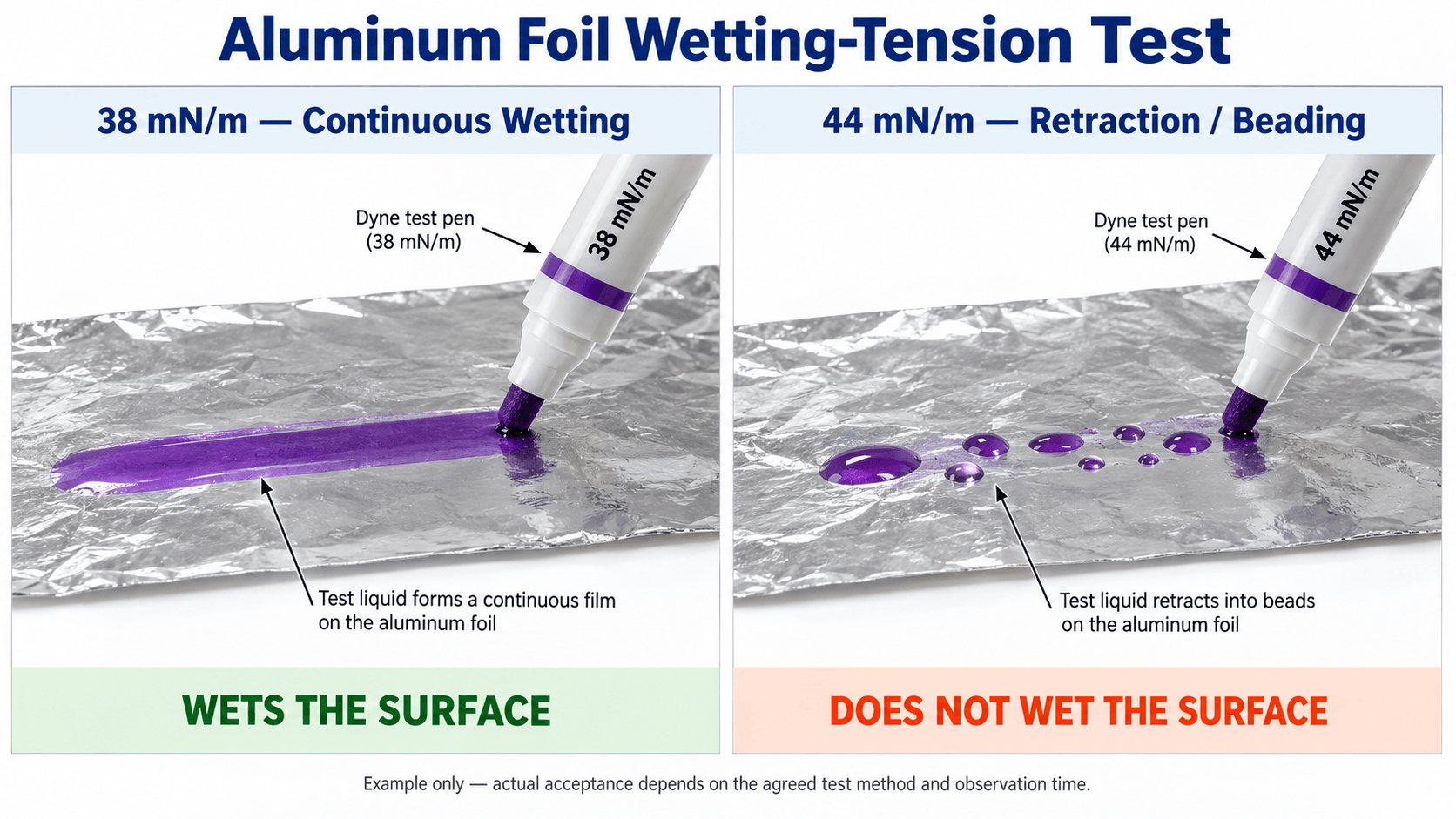
Dyne level is commonly used in converting operations as shorthand for a surface’s wetting response. A test liquid with a known surface tension is applied to the foil. If it spreads and stays continuous under the agreed observation rule, the surface is considered wettable by that liquid. If the liquid quickly pulls back, breaks or forms beads, it does not wet the surface under those test conditions.
For purchasing and quality control, the measured value should be treated as an operational test result, not as a complete chemical description of the foil surface. Rolling-oil residue, fingerprints, dust, cleaning chemistry, oxidation, storage, handling and test technique can all affect the observed result.
Are dyn/cm and mN/m the Same?
For surface tension or wetting tension, the numerical values are equivalent:
NIST lists 1 dyne as 10−5 newton. Dividing by one centimetre gives 10−3 N/m, which is 1 mN/m. A specification written as 40 dyn/cm therefore has the same numerical magnitude as 40 mN/m. However, matching units do not make results comparable if the laboratories used different test liquids, procedures or observation criteria.
How Is Aluminum Foil Wetting Tension Tested?
An aluminum-foil-specific reference is GB/T 22638.4-2016, “Test methods for aluminium and aluminium alloy foils—Part 4: Determination of surface wetting tension.” The official Chinese national-standard record identifies it as a current standard for this purpose.
At a practical level, the workflow is:
- Condition and identify the sample. Record the roll or lot, foil side, position across the width, sample age and relevant environmental conditions.
- Protect the test surface. Do not touch the area with bare hands or place it on a contaminated bench.
- Apply the specified test liquid. Use the agreed application method, solution condition and test direction.
- Observe liquid behavior. Judge whether the applied liquid remains continuous or retracts within the time and visual criteria defined by the method.
- Bracket the result. When the procedure requires it, use adjacent test-liquid levels to identify the highest passing or appropriate boundary value.
- Record, do not average away failures. Report individual locations, side, minimum result and any non-uniform area according to the agreed sampling plan.
Dyne Pens, Test Solutions and Contact Angle
| Method | Useful For | Main Limitation |
|---|---|---|
| Dyne pen | Fast shop-floor pass/fail screening when the procedure is controlled. | The tip can be contaminated by the surface; age, storage and operator interpretation affect results. |
| Test solution with applicator | More controlled bracketing across several liquid levels. | Requires careful liquid handling, clean applicators, consistent film application and safety controls. |
| Contact-angle measurement | Instrumented comparison of wettability and surface uniformity. | A contact angle does not directly provide a universal adhesion value and depends on the test liquid and method. |
| Process adhesion test | Validating the actual ink, coating or adhesive after defined curing or aging. | Application-specific; the test and acceptance criterion must be agreed for the finished structure. |
ASTM D7334 covers advancing contact-angle measurement for coatings and substrates and explains that contact angle can characterize wettability. It also states that contact angle does not directly give a surface-tension value. This is why “contact angle,” “surface energy,” “surface tension” and “dyne level” should not be used as interchangeable report headings.
Why Dyne Level Does Not Guarantee Adhesion
Good wetting helps an ink, coating or adhesive make intimate contact with foil, but adhesion also depends on chemistry and process control. Two foil samples can show the same dyne result yet behave differently after printing or lamination.
The correct sequence is therefore: use wetting tension as an incoming or process-control indicator, then validate the actual converted structure with an agreed adhesion, peel, heat-seal or end-use test.
Is There a Standard Dyne Level for Aluminum Foil?
There is no single value that is automatically correct for every foil application. A suitable target depends on the foil surface, intended ink or adhesive, coating chemistry, converter process, test method and time between testing and conversion.
Internet charts may show different “typical” aluminum values, but these should not be copied into a purchase order without process evidence. The converting-material supplier should identify the required wetting condition, and the buyer should validate it using representative foil and the actual production route.
What Can Cause a Low or Inconsistent Result?
| Observation | Possible Check | Do Not Assume |
|---|---|---|
| Low result across the sample | Verify sample identity, tested side, oil or contaminant condition, solution validity and test procedure. | Do not conclude from one reading that the alloy chemistry is wrong. |
| High center, low edges | Repeat at defined cross-width positions and examine handling, edge contamination and process uniformity. | Do not report only the center value as representative of the roll. |
| Different results between laboratories | Compare method edition, liquid system, application, observation time, environment and operator training. | Do not average results produced by non-equivalent procedures. |
| Acceptable dyne result but poor lamination | Review adhesive compatibility, coat weight, cure, nip, aging and peel-test conditions. | Do not treat dyne level as proof of bond strength. |
What Buyers Should Put on the RFQ or Purchase Order
For broader grade selection, see Aluminum Foil Grades for Packaging and Industrial Uses. For foil, strip and coil selection by packaging process, see Aluminum Packaging Materials: Foil, Strip and Coil Selection.
What Should an Inspection Report Include?
A useful wetting-tension report connects the result to the material and the procedure. It should identify the supplier, customer order, alloy and temper, nominal dimensions, coil or lot number, sample position, tested side, test method and edition, test-liquid identification, test date, relevant environmental conditions, individual readings, minimum result, acceptance limit, disposition and inspector.
If the foil will be laminated or printed after storage or international transport, agree whether incoming retesting is required. A production certificate records the condition at the stated test time; it cannot guarantee that an opened or contaminated surface will remain unchanged indefinitely.
Frequently Asked Questions
What is a dyne level?
It is a practical wetting-tension result based on how a known test liquid behaves on a surface. Higher test-liquid values that remain continuous generally indicate better wetting under the specified method.
What does a dyne value measure?
It indicates the wetting behavior between the test liquid and the tested surface. It does not directly measure peel strength, bond strength, cleanliness chemistry or coating durability.
Is surface tension measured in dynes per centimeter?
Dyn/cm is a commonly used non-SI unit. The corresponding SI expression is mN/m, and the two have the same numerical value for surface or wetting tension.
How do you test the dyne level of aluminum foil?
Use an agreed aluminum-foil wetting-tension method, controlled test liquids and defined sampling. Apply the liquid without contaminating the surface, observe whether it stays continuous under the method’s time criterion, bracket the result when required and record individual locations.
Is aluminum foil hydrophobic or hydrophilic?
A simple permanent label is not sufficient for purchasing. The observed behavior depends on the actual foil surface, oxide, oil or contamination, any treatment, the test liquid and test conditions. Measure the supplied surface using the agreed method.
Does a higher dyne level guarantee better lamination?
No. It indicates improved wetting potential under the test conditions, but lamination also depends on adhesive compatibility, application, cure, aging and end-use conditions. Confirm performance with an agreed process and adhesion test.
Should both sides of foil be tested?
Test the side or sides that will receive ink, coating or adhesive. If the sides have different appearance, treatment or process history, identify and report them separately rather than assuming one result represents both.
Conclusion
Aluminum foil dyne level is most useful when it is part of a controlled specification. A number without a method, side, sampling plan and test time can create a false sense of precision. Use wetting tension to monitor surface condition, then use the actual ink, coating or adhesive process to prove final performance.
Request an Aluminum Foil Specification Review
Send SASA ALUMINUM your alloy, temper, thickness, width, application, surface condition, wetting-tension method, target value, tested side, sampling requirement, coil size, quantity and destination for review.
Post time: Oct-12-2026