Aluminum foil pinholes are small through-openings that allow light to pass through plain foil. They matter because a foil layer is often selected for barrier performance, printing, lamination, insulation or electrical use. A buyer should not rely on the word “pinhole-free” alone. The purchase specification needs an agreed inspection method, sample area, counting rule, size rule, sampling frequency and acceptance limit.
What Is a Pinhole in Aluminum Foil?
In aluminum-industry terminology, a pinhole is a small void in thin foil, normally round or oval and randomly distributed. It should be distinguished from larger holes, regularly repeating roll holes, and cracks created later during forming, flexing or package conversion. The exact classification and acceptance rule should come from the applicable specification rather than from appearance alone.
Pinholes are easiest to see when light passes through the foil. A dark mark, surface stain or shallow impression may look serious under reflected light but may not be a through-hole. Conversely, a very small through-opening can be difficult to confirm without transmitted light.
Why Do Foil Pinholes Matter?
The practical effect depends on the full product construction and the application. In plain foil, a through-opening can reduce local barrier continuity. In a laminate, the other layers may remain intact, so a visible light point in the aluminum layer does not automatically prove that the finished package leaks. The final structure, seals, converting process and validated acceptance method must be evaluated together.
| Application | Why pinhole control is discussed | What the buyer should define |
|---|---|---|
| Flexible packaging | Barrier continuity before lamination and conversion | Foil-layer criteria and finished-package validation |
| Pharmaceutical foil | Protection and package-integrity requirements | Applicable specification, sampling and traceability |
| Battery or electrical foil | Local discontinuities may affect downstream coating or inspection | End-use defect definition and instrument method |
| Insulation and shielding | Continuity requirements vary with the complete system | Functional test and permitted defect level |
Review the available product form before fixing the inspection requirement.
How Does Light-Table Pinhole Inspection Work?
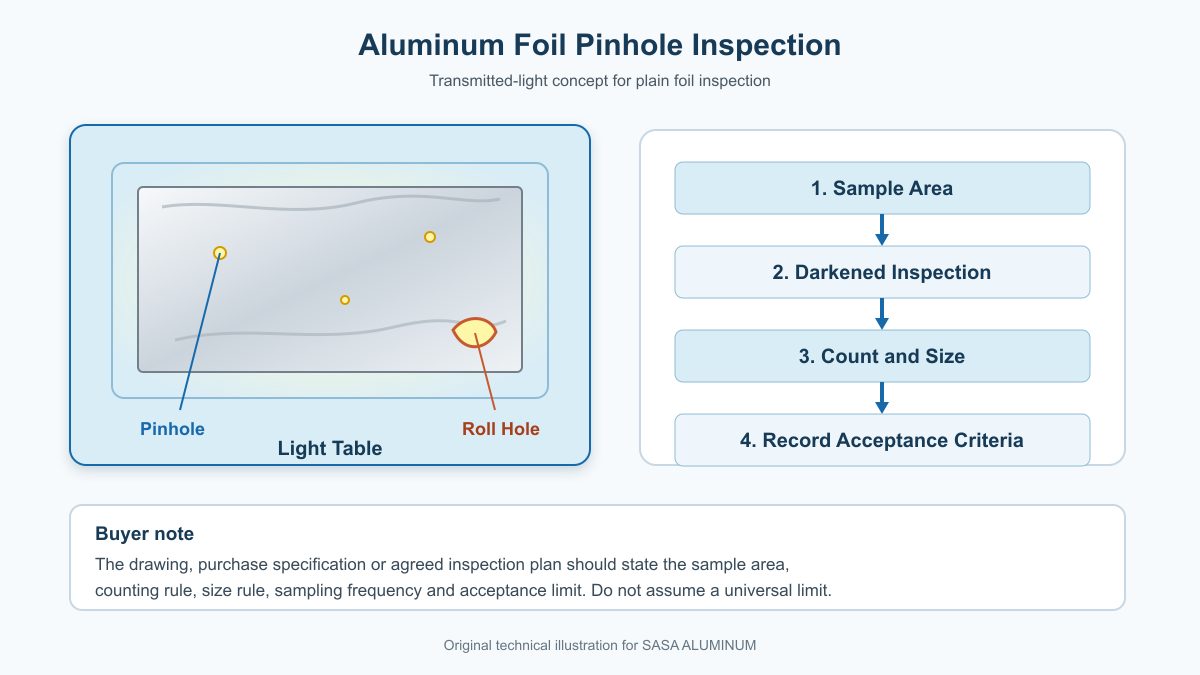
ASTM B926 covers identification and counting of pinholes, including roll holes, in plain aluminum and aluminum-alloy foil using a light table, a darkened inspection area and an inspector with normal or corrected vision. The method supports consistent evaluation, but the purchase document must still define the acceptance decision.
- Condition and identify the sample. Record the coil, roll, lot, width, thickness and sampling location.
- Define the inspected area. Use the area and number of specimens required by the agreed plan.
- Inspect by transmitted light. Place the plain foil over the illuminated surface in a darkened area and prevent folds or handling damage.
- Count and classify. Record pinholes separately from larger or repeating holes when the specification makes that distinction.
- Measure when required. A basic visual count is not automatically a precise size measurement. Use the agreed optical or instrument method if diameter limits matter.
- Report against the order. State the method, area, count, size category, sampling location and disposition.
Pinhole, Roll Hole, Perforation or Flex Crack?
| Observation | Typical pattern | Investigation direction |
|---|---|---|
| Pinhole | Small, often round or oval, randomly distributed | Foil gauge, rolling condition and incoming quality |
| Roll hole | Larger opening that repeats at regular intervals | Rolling surface, repeating contact or embedded particle |
| Random perforation | Larger irregular opening without a repeating pitch | Handling, foreign material or isolated process damage |
| Flex crack or formed crack | Develops after bending, forming, creasing or repeated flexing | Converting route, laminate design and forming severity |
What Causes Pinholes and Similar Openings?
Thin foil is more sensitive to local reductions and small particles than heavier foil. Potential origins include inclusions or particles carried through rolling, local surface damage, repeating roll-surface conditions, folding, abrasion and downstream forming. These are investigation directions, not automatic conclusions. The defect pattern, pitch, sample location and process stage should be reviewed before assigning responsibility.
Separate incoming-foil inspection from converting inspection. A roll that passes an incoming light-table check can still develop cracks during aggressive forming or flexing. A laminate may also show a light point in the foil layer while its polymer layers remain continuous. Use a finished-package integrity method when the decision concerns the complete package rather than plain foil alone.
What Should an Aluminum Foil RFQ State?
- alloy and temper required by the governing specification;
- plain, coated, lubricated, embossed or laminated condition;
- nominal foil thickness, width, roll dimensions and quantity;
- final application and converting route;
- pinhole inspection method and applicable standard;
- sample area, number of samples and sampling positions;
- maximum permitted count and any size categories;
- whether roll holes, perforations and edge defects are reported separately;
- required inspection record, lot traceability and packaging protection.
A phrase such as “no pinholes” can be difficult to apply unless the foil thickness, inspected area, detection method and sampling plan are also defined. For critical applications, the purchaser’s technical specification should state the actual acceptance rule.
Receiving Inspection Checklist
- Confirm the roll label, certificate and purchase order refer to the same lot and condition.
- Inspect packaging for water exposure, impact, edge damage or telescoping before opening.
- Take specimens according to the agreed sampling plan rather than only from an easy-to-reach location.
- Record the inspected area and separate pinholes from handling tears or knife damage.
- Retain images and sample-location records when a claim may require joint review.
Frequently Asked Questions
Are pinholes normal in aluminum foil?
The likelihood of pinholes generally increases as foil becomes thinner, but acceptance depends on the agreed product specification and end use. Do not infer acceptance from thickness alone.
Does a light table measure pinhole diameter?
A light table is suitable for locating and counting transmitted-light defects. If a diameter threshold is part of acceptance, the order should identify the measurement method and resolution.
Does a pinhole in laminated foil mean the package leaks?
Not necessarily. Other laminate layers may remain continuous. Evaluate the complete package with the method required for its actual barrier or integrity claim.
Can a supplier quote a pinhole limit without the application?
A meaningful review needs the foil condition, thickness, intended use, inspection area, sampling plan and acceptance rule. Share these details with the RFQ.
Send the alloy, temper, thickness, width, roll dimensions, application, converting route, pinhole method, sample area, acceptance limit, quantity and documentation requirements for a material review.
Post time: Oct-29-2026