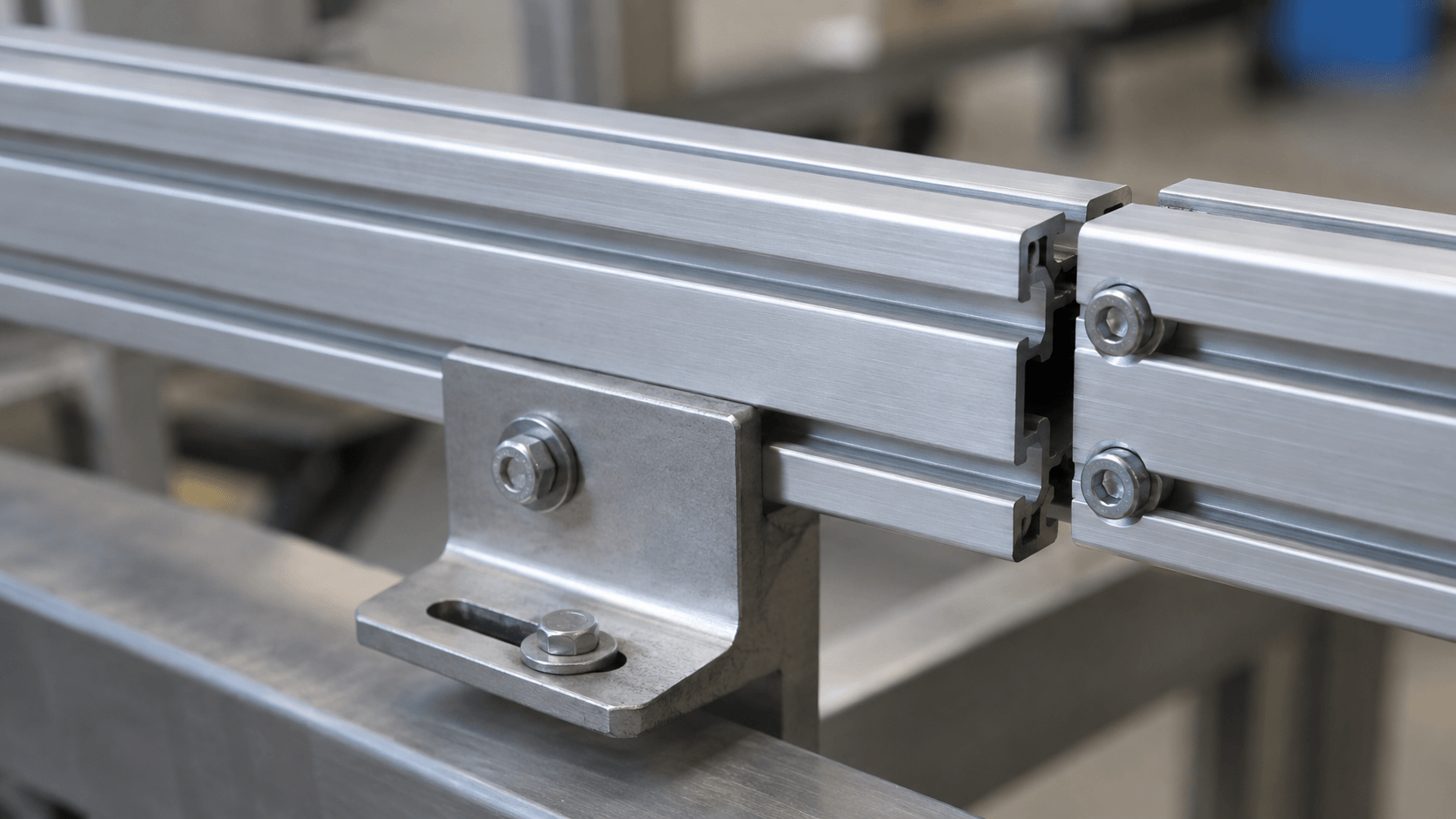
Aluminum expands when heated and contracts when cooled. For an unrestrained profile, estimate the length change with ΔL = α × L × ΔT. This predicts free movement; it does not by itself specify the required joint gap, fastener slot or safe operating temperature.
Long rails, frames, trim sections and enclosures need a mounting arrangement that accommodates the expected movement without losing alignment, support or weather sealing. Buyers should provide the service temperature range and mounting details alongside the alloy and section drawing.
How to Calculate Aluminum Length Change
In the equation, ΔL is the change in length, α is the mean linear coefficient of thermal expansion over the temperature interval, L is the original length and ΔT is the temperature change. Use consistent units: with L in millimeters and α per degree Celsius, the result is in millimeters.
A worked example for a long profile
Hydro’s published 6063 data sheet gives an average coefficient of 13.0 × 10⁻⁶ per degree Fahrenheit over 68–212°F. Converting the temperature unit gives approximately 23.4 × 10⁻⁶ per degree Celsius over 20–100°C. This is a published reference property, not a measured value for a SASAALUMINUM shipment.
For an illustrative 6,000 mm unrestrained 6063 profile warming from 20°C to 60°C: ΔL = 23.4 × 10−6 × 6,000 × 40 = 5.616 mm, or about 5.6 mm. The approximate final length is 6,005.6 mm. Cooling through the same interval produces a corresponding contraction under the same simplified assumptions.
The example assumes uniform temperature and unrestricted movement. It does not account for joint geometry, restraint, thermal gradients or installation tolerance. For final design, confirm the applicable alloy data and temperature interval rather than treating one coefficient as universal.
Free Expansion Is Different from Installation Clearance
The fixing arrangement determines where movement appears
If one end is fixed and the remaining supports permit sliding, most free movement may appear toward the other end. With a central reference point and a properly designed sliding arrangement, movement may be shared between the ends. A drawing should identify the fixed point and permitted movement directions.
Do not automatically divide the calculated movement by two. That assumption is only appropriate when the mounting geometry and restraint justify it. Similarly, a slot’s useful travel is smaller than its overall length once the fastener, washer, installation position and tolerances are considered.
Include both heating and cooling from installation temperature
An assembly installed during mild weather must accommodate movement toward its maximum and minimum service temperatures. Define the installation or reference temperature and check each direction separately. Include manufacturing and installation variation, sealing engagement and the necessary clearance to adjacent parts.
A material expansion calculation is an input to joint design, not the completed design. Structural, glazing, weatherproofing or safety-critical connections require the responsible designer’s review.
What Happens If an Aluminum Profile Is Restrained?
Restraint can turn thermal movement into force. Depending on the system, this may contribute to bowing, joint loading, fastener stress or contact with neighboring components. The outcome depends on stiffness, support spacing, friction and connection behavior. Free-expansion movement alone cannot establish the stress in a restrained assembly.
Temperature gradients also matter. A sun-exposed face and a shaded face may heat differently, and a long rail may not have the same temperature along its full length. Local distortion is therefore possible even when a simple average-temperature calculation appears acceptable.
Check Mixed-Material Assemblies Separately
When aluminum is connected to steel, glass, plastics or other materials, their movements may differ. Compare the appropriate expansion data, geometry and actual temperature exposure for each component. A flexible seal or sliding connection must accommodate relative movement while retaining its required function.
Corrosion isolation is a separate requirement. A washer or gasket that helps separate dissimilar metals does not automatically provide sufficient movement capacity. Define electrical isolation, mechanical support and thermal travel independently.
What Buyers Should Put in an Aluminum Profile RFQ
Provide the alloy and temper, section drawing, length, quantity and dimensional tolerance. Add the minimum and maximum service temperatures, reference temperature, mounting positions and any fixed-point or sliding-support concept. Identify finishing, machining and sealing requirements where they influence the connection.
For architectural frames and trim, review the 6063-T5/T6 aluminum extrusion profile range. Alloy and temper selection still need to satisfy the project’s strength, fabrication and finish requirements; thermal expansion is only one part of the decision.
Ask the supplier to distinguish standard dimensional requirements, published typical physical properties and actual inspection results. If a coefficient is not measured for the order, it should not be presented as a shipment test value. Agreement on the section and cut length does not mean the supplier has approved the final installation design.
Frequently Asked Questions
Does a T6 temper eliminate expansion?
No. Temper identifies a material condition, not an absence of thermal movement. Use appropriate expansion data and evaluate mechanical requirements separately.
Can I use ambient air temperature for ΔT?
Only if it reasonably represents the component temperature. Sun exposure, process heat and enclosure conditions can make metal temperatures different from ambient air. Establish a defensible service range for the assembly.
Does a larger gap always solve the problem?
No. Excessive clearance can compromise alignment, sealing or engagement. Joint clearance must work with the support and fastening design throughout the operating range.
Reference for the coefficient used in the example: Hydro: Alloy 6063 data sheet. The numerical example is a calculation using that reference value, not an installation recommendation.
Preparing a profile purchase? Send the section drawing, alloy, temper, cut lengths and mounting-related machining requirements so our team can review the material supply specification.
Post time: Sep-18-2026