Aluminum Tooling Plate vs 6061 Rolled Plate: Selection Guide
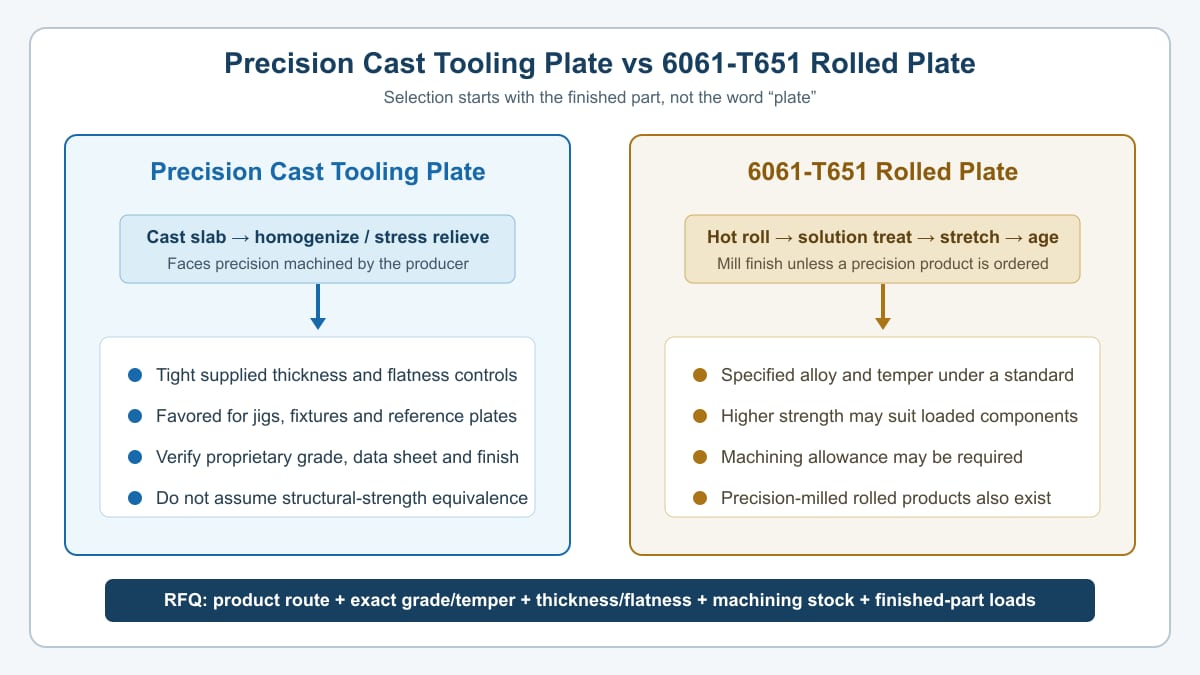
Aluminum tooling plate and 6061-T651 rolled plate are not interchangeable descriptions. Precision cast tooling plate is normally selected for supplied flatness, thickness consistency and dimensional stability during machining. 6061-T651 rolled plate is a wrought, heat-treatable product chosen when specified alloy properties, strength, weldability and standard coverage matter. The correct choice depends on the finished part, machining sequence, loads, surface finish and inspection requirements.
Quick answer: choose precision cast tooling plate for fixtures, vacuum tables, templates and machine bases where flatness and low machining distortion are primary. Choose 6061-T651 rolled plate when the drawing requires a recognized wrought alloy-temper, higher structural strength or properties covered by ASTM B209/B209M. Do not choose by trade name alone; compare the producer data sheet and the finished-part requirements.
What Is Aluminum Tooling Plate?
“Tooling plate” is a commercial product description rather than one universal alloy. Precision cast products are made from a cast slab, homogenized or otherwise stress relieved, then machined on both faces. Product families such as ATP-5 and ALCA5 publish their own alloy basis, thickness range, flatness, surface roughness and typical mechanical properties.
For example, Vista Metals identifies ATP-5 as an aluminum-magnesium precision tooling plate with machined faces and dimensional-stability controls. PCP identifies ALCA5 as a precision cast AA5083 product for reference plates, tools, jigs and mold bases. These examples show why the purchase order must name the exact product or an agreed equivalent instead of requesting only “cast aluminum plate.”
What Is 6061-T651 Rolled Plate?
6061 is a wrought aluminum-magnesium-silicon alloy. In plate, T651 indicates solution heat treatment, stress relief by stretching and artificial ageing. ASTM B209/B209M covers specified aluminum-alloy sheet and plate products in listed alloys and tempers, but the purchase order must still state the applicable edition, dimensions, finish and any supplementary requirements.
Ordinary mill-finish 6061-T651 plate should not be assumed to have the same supplied surface or thickness tolerance as a precision-machined tooling plate. However, rolled precision-plate products also exist. Constellium describes its Alplan range as specialty rolled plate with controlled flatness, dimensional stability and machined faces. The real comparison is therefore between defined product specifications, not simply “cast is flat and rolled is not.”
Cast Tooling Plate vs 6061-T651: Key Differences
| Selection point | Precision cast tooling plate | 6061-T651 rolled plate |
|---|---|---|
| Product identity | Producer-specific precision cast product | Recognized wrought alloy and temper |
| Supplied faces | Usually precision machined and protected | Normally mill finish unless a precision product is specified |
| Primary advantage | Flatness, thickness control and machining stability | Strength, established alloy-temper properties and broad fabrication use |
| Design basis | Named mill data sheet and drawing requirements | ASTM B209/B209M or another specified product standard plus drawing |
| Common use | Jigs, fixtures, templates, reference plates, vacuum tables | Machine parts, brackets, structural plates and welded fabrications |
Which Plate Is More Dimensionally Stable?
Dimensional stability means the part changes as little as practical when material is removed or temperature changes. Precision cast tooling plate is produced specifically to reduce internal stress and is therefore a common choice for heavily machined, flat components. That does not mean every cast plate is distortion-free, and it does not mean every rolled plate is unstable.
Machining distortion also depends on stock-removal balance, fixturing, heat from cutting, part geometry and the ratio of final thickness to starting thickness. For critical parts, remove material symmetrically where possible, plan intermediate stress checks and verify flatness after unclamping and thermal stabilization.
Does Tooling Plate Have Better Flatness?
A named precision tooling plate normally publishes tighter supplied flatness and thickness controls than ordinary mill-finish plate. The values are not universal. They vary with product family, thickness, blank size, edge condition and measurement method. Saw-cut blanks may also behave differently from full mill plates if cutting and handling are not controlled.
Tolerance caution: ANSI H35.2 covers dimensional tolerances for aluminum mill products, but the Aluminum Association has clarified that published mill-finish tolerances do not automatically apply after distributor slitting, shearing, sawing, blanking or additional surface processing. State the finished blank tolerance and inspection method in the RFQ.
Is Tooling Plate Stronger Than 6061?
Not as a general rule. A tooling plate may be optimized for flatness and machinability rather than structural strength. Some proprietary 5xxx cast tooling plates publish higher typical strength than other cast products, but these values must not be substituted for 6061-T651 design allowables. If the component carries structural load, the engineer should select a documented alloy-temper and use the approved design basis for the actual product form and thickness.
Machining and Surface-Finish Considerations
Can the supplied tooling-plate face be used as finished?
Sometimes, but only when the mill surface roughness, protective-film condition, thickness tolerance and cosmetic requirements meet the drawing. A precision-machined mill face is not automatically a sealing, optical or cosmetic surface.
How much machining allowance is needed?
Tooling plate may reduce facing stock because both surfaces are supplied machined. Rolled mill plate may need additional allowance to clean up surface variation and achieve final parallelism. The correct allowance depends on starting tolerance, blank size, final thickness, flatness target and clamping plan.
Can both products be anodized or welded?
Possibly, but appearance and procedure depend on the exact product. Some 5xxx tooling plates are promoted for welding and hard anodizing while decorative color uniformity may be limited. 6061 is commonly welded and anodized, but welding changes local properties and anodized appearance depends on composition, temper and surface preparation. Obtain producer guidance before specifying the finish.
How to Choose for a CNC Part
| Finished-part priority | Starting point | Confirm before ordering |
|---|---|---|
| Flat fixture or vacuum table | Precision cast tooling plate | Flatness, thickness, porosity or pressure-integrity requirement, surface finish |
| Loaded machine component | 6061-T651 or another engineered wrought plate | Design properties, standard, thickness range, grain direction and inspection |
| Heavy two-sided machining | Compare low-stress cast and precision rolled products | Stock-removal test, released flatness and dimensional-stability data |
| Cosmetic anodized part | Select by finish trial, not only machinability | Alloy, surface preparation, acceptable color variation and sample approval |
RFQ Checklist
- exact product name, producer or approved-equivalent rule;
- alloy, temper and governing product specification where applicable;
- starting thickness, width, length and quantity;
- thickness tolerance, parallelism and flatness after release from clamping;
- saw-cut blank tolerance and edge condition;
- surface roughness, protective film and cosmetic acceptance;
- machining allowance and amount removed from each face;
- finished-part load, operating temperature and corrosion exposure;
- certificate, traceability and any porosity, pressure-integrity or inspection requirement.
Frequently Asked Questions
Is MIC-6 the same as 6061?
No. MIC-6 is a proprietary precision cast tooling-plate product, while 6061 is a registered wrought alloy designation supplied in defined tempers such as T651.
Is all 5083 plate tooling plate?
No. Some proprietary precision cast plates use a 5083-based composition, but wrought 5083 plate is a different product route with different temper, standard and property requirements.
Can tooling plate be used for structural parts?
Only after engineering review using valid properties and an approved specification for the exact product. Tooling-plate flatness does not establish structural design allowables.
Is rolled tooling plate available?
Yes. Specialty rolled plates can be stress controlled and precision machined. Compare the named product data rather than assuming tooling plate must always be cast.
Request a Plate Specification Review
Review the SASA ALUMINUM sheet and plate range, then send the product route, alloy-temper, dimensions, quantity, machining plan, final flatness and inspection requirements.
Post time: Oct-20-2026