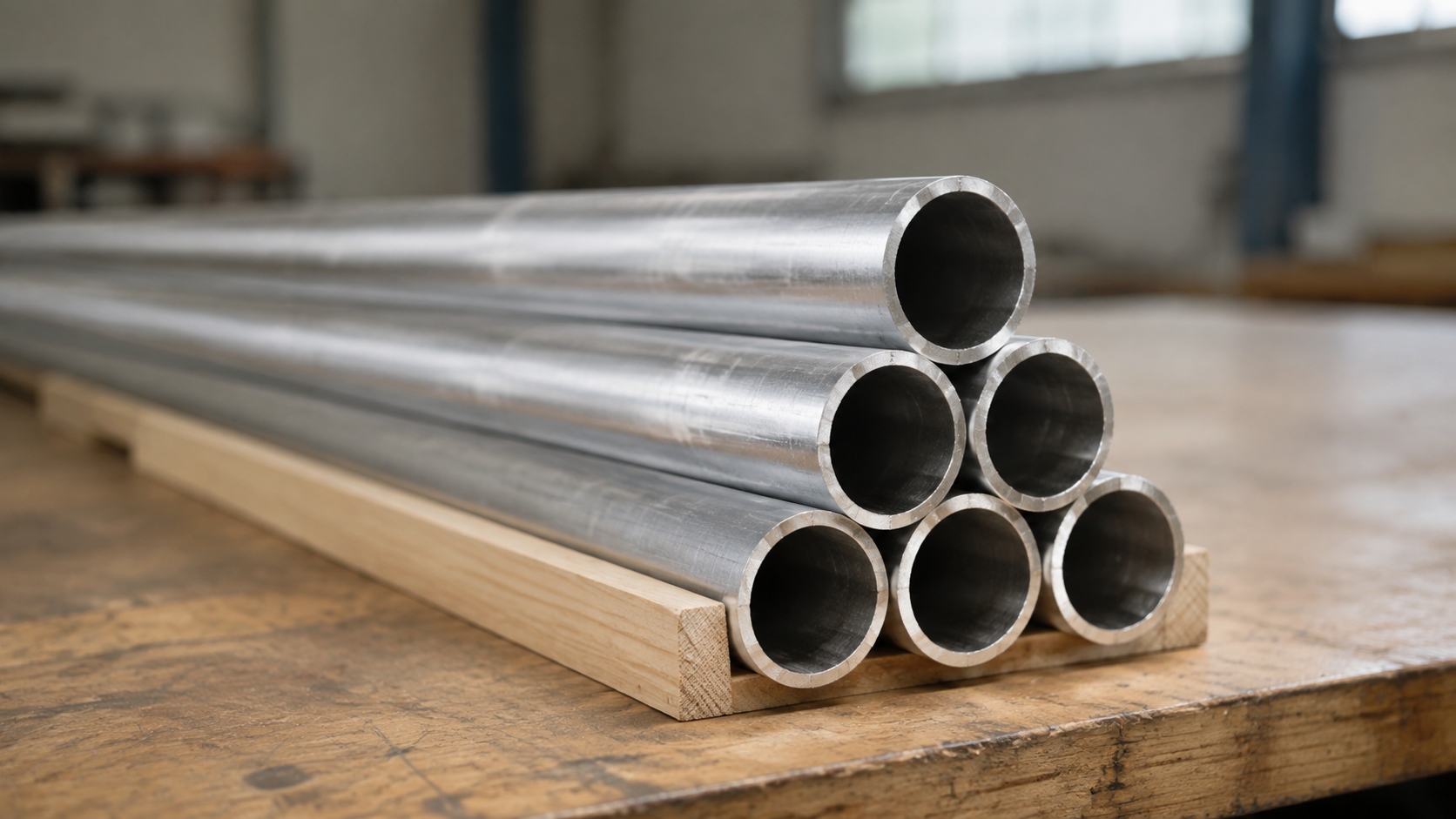
Cold drawing and seamless extrusion are related routes, not automatic strength grades. A drawn seamless tube can start from seamless extruded stock and undergo further dimensional reduction. Choose between offers by the finished alloy, temper, tolerances, surface condition and inspection—not by assuming that “drawn” always means stronger or pressure-rated.
First Confirm What “Seamless” Means
A hollow aluminium extrusion is not necessarily seamless. A porthole or bridge die can divide the metal flow and reunite it, creating longitudinal extrusion welds. If the drawing requires seamless material, the production route and applicable product specification must explicitly support that requirement. The absence of a visible weld bead is not sufficient evidence.
Seamless tube production and subsequent drawing need to be considered together. Drawing changes dimensions and can change the material condition, but the final properties also depend on alloy and any heat treatment after working. Two tubes with the same nominal dimensions may therefore differ in supplied condition and acceptance requirements.
What to Compare on a Tube Quotation
| Requirement | Why it matters |
|---|---|
| Outside diameter and wall | Specify nominal values and permitted variation; include ovality or eccentricity when critical. |
| Alloy and temper | Provides the correct basis for mechanical-property acceptance. |
| Surface condition | Distinguish an as-produced finish from a specified roughness or defect limit. |
| Straightness and length | Identify cut length, end condition and the measurement basis. |
| Inspection | State applicable dimensional, material and non-destructive testing requirements. |
Precision and processing
Cold drawing is commonly selected when further dimensional control or finishing is needed. That does not justify a universal tolerance claim: use the actual standard and agreed drawing limits. A seamless extrusion may meet the application without the extra operation, while a precision assembly may justify drawing or subsequent machining.
Strength and pressure service
Do not infer allowable pressure from the word “seamless” or from a general tensile-strength statement. A pressure-containing design must account for the specified material properties, wall thickness, service temperature, connections and applicable design rules. Testing also needs a defined method and acceptance criterion; a generic certificate description is not enough.
Use a Standard That Matches the Product
ASTM B210/B210M addresses drawn seamless aluminium and aluminium-alloy tubes. ASTM B241/B241M addresses seamless pipe and seamless extruded tube. Their alloy, temper, dimension and testing provisions must be checked for the intended order. A specification covering sheet or plate should not be listed as proof of tube compliance.
If using an EN specification, identify the relevant part and product category rather than writing only “EN 754” or “EN 755.” Ask the supplier to confirm which ordered requirements are covered and identify any additional drawing tolerances. Never treat a list of standard numbers as interchangeable certification options.
A Practical Selection Sequence
- Start with the approved drawing and determine whether seamless construction is mandatory.
- Fix the alloy, temper, dimensions and service conditions.
- Identify which dimensions or surface characteristics drive the need for drawing.
- Compare the proposed routes against the same inspection and documentation scope.
- Review substitutions before production, including changes in route, temper or standard.
This approach is more useful than selecting extrusion for “general use” and drawing for “critical use.” Both routes can serve demanding applications when the complete product specification is appropriate; neither route guarantees suitability on its own.
Prepare a Tube Inquiry
Review the aluminium pipe and tube range and send the drawing, alloy, temper, outside diameter, wall, length, quantity and required tests. State explicitly whether extrusion-welded hollow material is prohibited. Include the destination and packaging requirements so that the quotation covers the actual delivery scope.
Discuss a Seamless Tube Specification
Specification scope reference: ASTM—Aluminium Wrought Product Specifications.
Manufacturing reference: Hydro—Seamless and Structural Aluminium Tube.
Post time: Aug-25-2025