5083 Aluminum Seamless Pipe: Standards, Tempers and RFQ Guide
5083 aluminum seamless pipe is often requested for marine and other corrosion-sensitive fabrications, but the alloy number alone is not a complete purchase specification. A reliable inquiry should identify whether the item is pipe or tube, the governing standard, temper, dimensions, service conditions, inspection requirements and required documents.
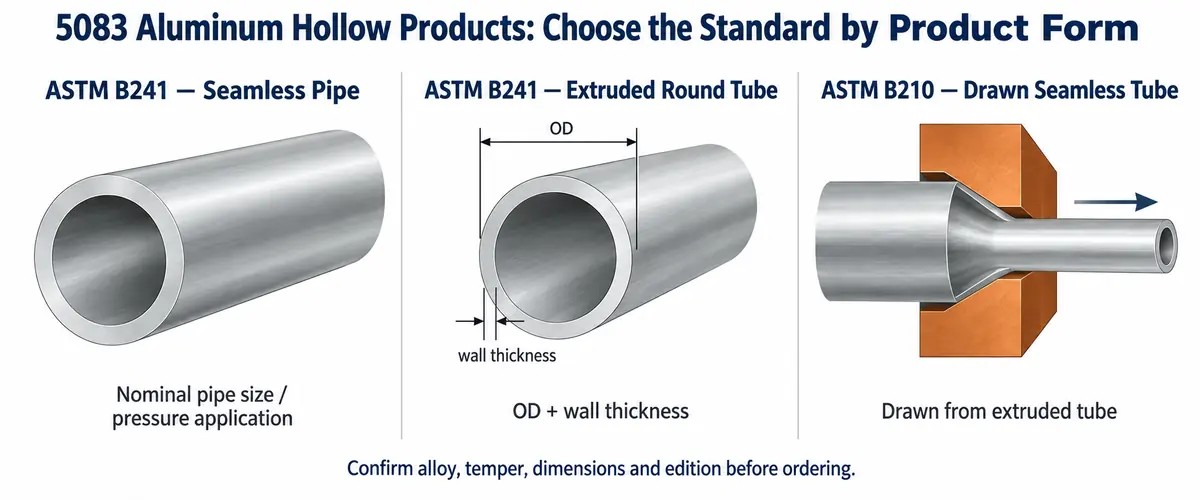
Quick answer: ASTM B241/B241M covers aluminum-alloy seamless pipe and seamless extruded round tube for pressure applications. ASTM B210/B210M covers drawn seamless tube. Select the standard from the actual product form and dimensional requirement, then confirm that the requested 5083 alloy, temper and size are included in the edition named on the purchase order.
Why Buyers Consider 5083 Aluminum
5083 is a non-heat-treatable aluminum-magnesium alloy known for useful strength, weldability and corrosion resistance in marine environments. It is widely recognized in plate and sheet, while availability as an extruded hollow product can be more specialized. For that reason, buyers should confirm the required form, temper and size with the manufacturer before freezing a design or delivery schedule.
Good resistance to seawater exposure does not make a component immune to corrosion. Crevices, stagnant solution, deposits, electrical contact with dissimilar metals and contaminated fabrication tools can still influence service performance. Material selection therefore needs to be considered together with joint design, drainage, isolation and the actual operating environment.
ASTM B241 vs ASTM B210: Pipe or Drawn Tube?
The terms pipe and tube are sometimes used interchangeably in inquiries, but they can lead to different standards and dimensional conventions.
| Standard | Primary scope relevant to the inquiry | Buyer should define |
|---|---|---|
| ASTM B241/B241M | Seamless pipe and seamless extruded round tube for pressure applications | Pipe size or tube dimensions, alloy, temper, length and applicable edition |
| ASTM B210/B210M | Drawn seamless tubes in straight lengths or coils for general-purpose and pressure applications | Outside diameter, wall thickness, temper, length and dimensional tolerances |
| ASTM B221/B221M | Extruded bars, rods, wire, profiles and tubes | Whether a general extruded tube, rather than pressure pipe under B241, is actually required |
| ASTM B928/B928M | Marine-service sheet, coiled sheet, plate and certain extruded profiles | Do not apply it to pipe automatically merely because the project is marine |
ASTM B241 notes standard pipe sizes in accordance with ANSI H35.2 and also covers seamless extruded round tube for pressure applications. ASTM B210 addresses tube produced by drawing extruded tube. If a drawing only says “5083 seamless tube” without dimensions and standard, the supplier cannot safely infer which route the designer intended.
What “Seamless” Does—and Does Not—Mean
A seamless hollow product has no longitudinal weld seam. Under ASTM B241, seamless pipe and seamless extruded tube are produced by extruding hollow ingot through a die and mandrel. Under ASTM B210, drawn seamless tube is produced by drawing an extruded tube to the required dimensions.
However, the word “seamless” by itself does not establish a pressure rating, prove fitness for seawater, define nondestructive testing or guarantee zero imperfections. Those requirements must come from the governing material standard, design code, service conditions, drawing and purchase order.
How to Specify Dimensions Correctly
For a pipe inquiry, state the nominal pipe size and schedule or the exact outside diameter and wall thickness required by the governing specification. For a tube inquiry, outside diameter and wall thickness are usually the clearest starting dimensions.
In either case, add:
- minimum and maximum wall requirements where design-critical;
- cut length and length tolerance;
- outside-diameter, inside-diameter or ovality limits when tighter than the standard;
- straightness, end preparation and surface-finish requirements;
- whether machining allowance is needed.
Do not rely on a nominal label alone when the part must fit an existing coupling, seal, heat exchanger or machined assembly.
Temper, Welding and Corrosion Questions
Which temper should be ordered?
Temper affects strength, formability and fabrication response. O and H112 are among the temper designations buyers may encounter for 5083 products, but the valid choices depend on product form, dimensions and the cited standard edition. Ask the supplier to confirm availability and do not copy a temper from a plate specification into a pipe inquiry without verification.
Is 5083 weldable?
5083 is generally considered weldable, but a finished assembly still depends on joint design, filler-metal selection, procedure qualification, cleanliness and control of heat input. Welding can change properties in the heat-affected zone. The fabrication code and service requirements—not a generic alloy description—should control acceptance.
Is 5083 suitable for seawater?
5083 is widely associated with marine applications because of its corrosion resistance, yet suitability remains application-specific. Temperature, flow, crevices, biofouling, cleaning chemicals and galvanic contact can all matter. A seawater system designer should assess the complete assembly rather than the pipe alloy in isolation.
Inspection and Documentation to Put on the RFQ
Testing should be specified rather than assumed. Depending on the standard and project, an RFQ may request:
- material test certificate with heat or lot traceability;
- chemical-composition and mechanical-property results required by the cited specification;
- dimensional inspection covering outside diameter, wall thickness, ovality, length and straightness;
- surface condition and end-finish criteria;
- nondestructive examination, leak testing or pressure testing only where required by the governing standard, code or purchase order;
- marking, packing and any third-party inspection requirement.
5083 Seamless Pipe RFQ Checklist
- Product form: seamless pipe, seamless extruded round tube or drawn seamless tube
- Standard and edition: for example, ASTM B241/B241M or ASTM B210/B210M
- Alloy and temper: 5083 plus the required temper
- Dimensions: nominal size/schedule or OD × wall thickness, plus length
- Quantity and unit of measure
- Service: fluid, pressure, temperature, marine exposure and joining method
- Tolerances, surface, ends and machining allowance
- Inspection, testing, traceability and certificate requirements
Frequently Asked Questions
Is ASTM B241 the same as ASTM B210?
No. ASTM B241/B241M covers seamless pipe and seamless extruded round tube for pressure applications, while ASTM B210/B210M covers drawn seamless tube. The manufacturing route and dimensional format should match the drawing and service requirement.
Is a 5083 aluminum pipe the same as a 5083 aluminum tube?
Not necessarily. “Pipe” often follows a nominal pipe-size system, while “tube” is commonly ordered by actual outside diameter and wall thickness. The standard and purchase dimensions decide the product—not the informal name used in an email.
Should I choose 5083 or 5086 aluminum pipe?
Both are aluminum-magnesium alloys used in corrosion-sensitive and marine work, but they are not automatic substitutes. Compare the product standard, temper, required mechanical properties, forming and welding plan, availability and project approval before making a substitution.
Can ASTM B928 be used for 5083 marine pipe?
ASTM B928/B928M is not a blanket pipe specification. Its scope covers marine-service sheet, coiled sheet, plate and certain extruded profiles. For seamless pipe, first evaluate the pipe-specific requirements of ASTM B241/B241M and the governing design code.
Send a Complete Inquiry
See the 5083 aluminum tube product page for the relevant product category. For a quotation review, contact SASA Aluminum with the standard, edition, temper, dimensions, quantity, service conditions and inspection requirements. The technical team can then evaluate whether the requested combination is commercially available.
Post time: Oct-16-2026