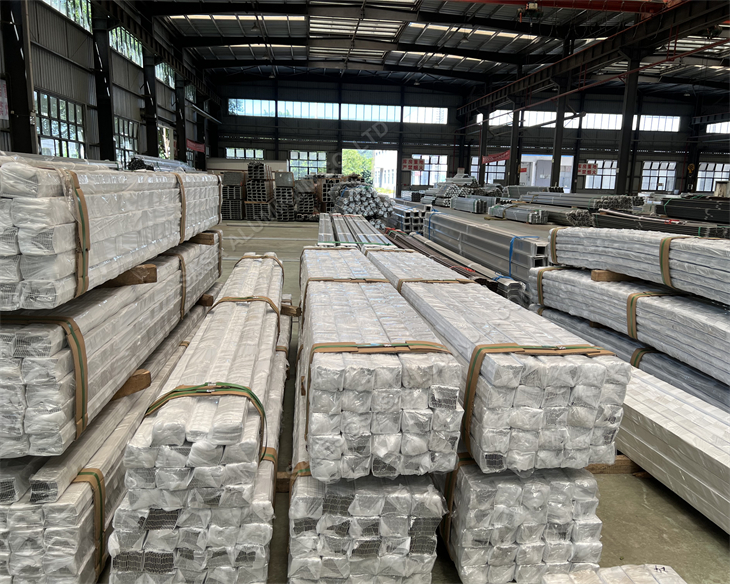
6061-T6 and 6082-T6 are both heat-treatable Al-Mg-Si extrusion alloys, but they should not be treated as automatic substitutes. In structural profile projects, 6082-T6 is often evaluated when higher mechanical strength is the priority, while 6061-T6 remains a widely used choice for welded, machined and general structural components. The final decision depends on the governing standard, section thickness, profile complexity, weld design, corrosion exposure and availability—not alloy name alone.
This guide compares the two alloys from an RFQ and engineering perspective so buyers can define a profile that is practical to extrude, inspect, machine and assemble.
Quick Decision: 6061-T6 or 6082-T6?
| Decision factor | 6061-T6 | 6082-T6 |
|---|---|---|
| Primary direction | General structural, marine, transport and machined extrusion applications. | Higher-strength structural profiles, frames and load-bearing components. |
| Relative T6 strength | Strong 6000-series baseline; required values depend on product standard and section. | Generally slightly higher mechanical properties than 6061 in T6, subject to standard and thickness. |
| Welded fabrication | Widely used for welded structures; design must account for heat-affected-zone strength reduction. | Weldable, but the same HAZ design check is essential; alloy choice alone does not preserve T6 strength at the weld. |
| Complex/thin-wall extrusion | Often considered where profile geometry and fabrication favor 6061 capability. | Thin or highly complex shapes may be more difficult; T6 capability must be confirmed for the actual cross-section. |
| Substitution rule | Never substitute solely from a generic property table. Validate the drawing, specification, design allowables, temper and section thickness. | |
Practical rule: choose 6082-T6 when the approved design requires its higher structural property level; choose 6061-T6 when the drawing, regional standard, weld procedure or established fabrication route is built around 6061. Ask for engineering approval before changing either alloy.
What the T6 Temper Actually Means
T6 means the extrusion has been solution heat-treated and artificially aged. This condition raises strength compared with annealed or naturally aged states, but “T6” is not a universal property value. Minimum tensile strength, yield strength and elongation depend on the alloy, product specification, profile type and the thickness of the section from which the tensile specimen is taken.
Hydro’s published 6082 extrusion data, for example, separates property limits by cross-section thickness and notes that the applicable thickness determines the mechanical-property requirement. For buyers, this means a value copied from a thin test piece should not be applied automatically to a thick solid profile or hollow section.
Confirm the complete temper designation
Some orders use T6511 rather than T6 where stretching is used for stress relief after solution heat treatment, followed by artificial aging. If machining stability, straightness or residual stress is critical, do not shorten the requirement to “T6” without checking the drawing and applicable standard.
Strength Comparison Must Follow the Product Standard
6082 is widely associated with structural extrusions and is described in European Aluminium guidance among alloys used for structural sheets and extrusions. Published producer guidance also characterizes 6082-T6 as having slightly higher mechanical properties than 6061-T6. This is a useful selection direction, but it is not a purchase acceptance table.
The RFQ should identify the governing standard—commonly EN 755 for extruded rod/bar/tube/profile dimensions and mechanical properties in European supply, or ASTM B221 for aluminum extruded bars, rods, wire, profiles and tubes in many international projects. State the standard edition required by the contract. Mechanical values must then be checked against the correct alloy, temper, product form, section type and thickness range.
| Do not compare only | Also confirm |
|---|---|
| One tensile-strength number | Yield strength, elongation, specimen direction and thickness range. |
| Alloy chemistry | Temper route, profile geometry, quench response and aging condition. |
| Base-metal T6 properties | Weld-zone design allowables and any post-weld treatment. |
Extrudability and Profile Geometry
A profile that looks simple in a material list may contain thin walls, deep cavities, unbalanced mass, narrow tongues or large thickness transitions that control die design and quenching. 6082 can be more demanding for thin-walled or complex profiles, and published extrusion guidance cautions that T6 may not be available for some shapes because of quenching limitations.
Information needed for feasibility review
- Dimensioned drawing with cross-section area, perimeter and critical wall thicknesses.
- Solid, semi-hollow or hollow profile classification and internal cavity details.
- Critical straightness, twist, flatness, angularity and cut-length tolerances.
- Areas requiring machining, welding, bending, anodizing or powder coating.
- Whether cosmetic surfaces or structural properties have first priority.
For the 6082 product range, review 6082-T6 aluminum extrusion profiles. If appearance and a different strength/forming balance are more important, the 6063-T5/T6 extrusion profile range may also provide a useful comparison; substitution still requires design approval.
Welding: Check the Heat-Affected Zone
Both 6061 and 6082 are considered weldable 6000-series alloys, but welding locally changes the precipitation-hardened condition. The heat-affected zone can have significantly lower strength than the unaffected T6 base metal. A structural calculation that uses only base-metal T6 properties at the joint is therefore incomplete.
The responsible engineer should define filler alloy, process, joint design, weld quality level, fatigue category and design allowables. If the assembly will be machined after welding, distortion control and datum strategy should be planned before production. Post-weld aging or other thermal treatment should not be assumed to restore the complete original property set without a qualified process.
Machining, Anodizing and Surface Requirements
6082-T6 is often selected for good machinability in structural components. 6061-T6 is also widely machined. For either alloy, the RFQ should state machining allowance, straightness before and after machining, surface defects that are unacceptable, and whether dimensional inspection applies before or after coating.
Anodizing response depends on alloy chemistry, extrusion practice, surface preparation and cosmetic acceptance criteria. A buyer requiring uniform decorative color should approve a sample or reference range rather than specify “anodized” alone. Structural profiles may prioritize strength and machining over the best decorative response, so the surface requirement must be realistic for the selected alloy.
Inspection and Product Testing
Product testing can be provided according to the confirmed standard and project scope. A typical inspection plan may include chemical composition verification, tensile testing, hardness where applicable, dimensional inspection, straightness/twist measurement, surface inspection and coating-thickness or adhesion checks after finishing. For traceability, specify certificate type and whether test results must correspond to the supplied lot.
For critical structural profiles, identify the sampling location and property direction because extrusion properties are directional. If first-article inspection, profile scanning, gauge reports or third-party witnessing is required, include those requirements before quotation and production planning.
RFQ Checklist for 6061-T6 or 6082-T6 Profiles
- Alloy, full temper and governing material/dimensional standard.
- 2D drawing and preferably a 3D model for custom profiles.
- Critical wall thicknesses, tolerances, straightness, twist and cut length.
- Quantity, required delivery lengths and acceptable extrusion-length strategy.
- Machining, drilling, bending, welding and assembly requirements.
- Mill finish, anodizing, powder coating or other surface requirements.
- Mechanical tests, dimensional report, traceability and certificate requirements.
- Application, load direction, service environment and destination country.
Need to compare 6061-T6 and 6082-T6 for a specific profile?
Send the drawing, standard, temper, quantity, finishing and inspection requirements for a practical supply review.
Post time: Sep-02-2026