Aluminum Sheet Oil Canning: Causes, Inspection and Prevention
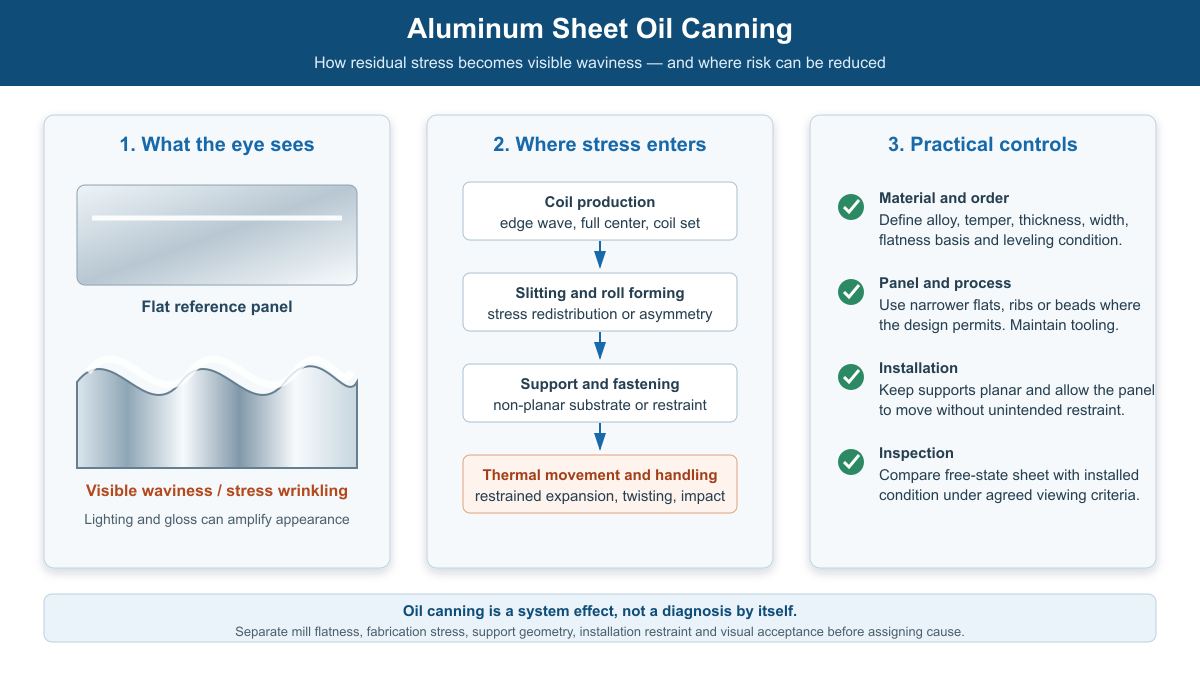
Aluminum sheet oil canning is visible waviness in a broad, nominally flat area. It is also called stress wrinkling, elastic buckling or a trapped buckle. The appearance can originate in the coil, be released during slitting or forming, or develop when a finished panel is forced onto an uneven support or prevented from moving with temperature. A photograph alone usually cannot identify the responsible stage.
Quick answer: treat oil canning as a system-level flatness and appearance issue. First compare the incoming sheet or coil in a free state with the fabricated and installed condition. Then review residual stress, slitting, roll forming, panel width-to-thickness ratio, support planarity, fastening, thermal movement and handling. Thicker material, narrower flats, stiffening features and properly specified leveling can reduce risk, but no single control guarantees a perfectly reflection-free surface.
What Is Oil Canning in Aluminum Sheet?
The Metal Construction Association defines oil canning as visible waviness in the flat areas of metal roof and wall panels and describes the technical condition as elastic buckling or stress wrinkling. The Aluminum Association uses trapped buckle (oil can) for smaller, often circular undulations in rolled sheet. These descriptions overlap, but they are not a substitute for an agreed inspection method.
Oil canning should also be distinguished from edge wave, center buckle, coil set, camber, a sharp crease and local impact damage. Each pattern points toward a different combination of differential length, residual stress, processing or handling.
Oil Canning vs Other Flatness Conditions
| Observed pattern | Useful description | First checks |
|---|---|---|
| Trapped buckle / oil can | Smaller wavy regions, often circular or irregular | Free-state sample, residual stress, forming and restraint |
| Edge wave | Undulations along one or both slit edges | Width profile, slitting, edge condition and leveling |
| Center buckle / full center | Waves concentrated near the strip center | Cross-width differential length and roll profile |
| Coil set | Longitudinal curvature following the wound coil | Coil diameter, temper, thickness and flattening process |
| Crease or handling kink | Sharp, localized departure from flat | Packaging, lifting, racks, rollers and contact points |
What Causes Aluminum Sheet Oil Canning?
1. Residual stress from coil production
Flat-rolled coil contains small differences in longitudinal strain across its width. Edge wave, full center and coil set can become more visible when the sheet is cut, formed or released from restraint. Higher strength, thinner material and a large unsupported flat width generally give the sheet less resistance to out-of-plane movement.
2. Slitting, leveling and panel forming
Slitting a wide master coil can release and redistribute residual stress. Roll forming then works the edges and profile features; an asymmetric setup, worn tooling, incorrect engagement or inconsistent feed may leave different stress levels across the panel. The result can be a flat blank that changes shape after further processing.
3. Support geometry and installation restraint
A panel fastened to a non-planar frame must conform to the support. Over-driven fasteners, excessive panel engagement, uneven clips or fixing from several points toward a trapped center can add compressive stress. Inspecting only the installed surface may therefore assign a substrate or installation effect to the sheet supplier incorrectly.
4. Thermal movement
Aluminum expands and contracts as panel temperature changes. If joints, clips or perimeter details do not allow the intended movement, the panel can bow between restraints. A wave that changes through the day is an important clue that temperature and restraint are involved.
5. Storage and handling
Twisting a long panel, lifting one corner, poor rack support or allowing a bundle to sag can introduce permanent or elastic distortion. Record the condition at receipt and again after fabrication so damage is not confused with an original mill flatness condition.
Is Oil Canning a Structural Defect?
Oil canning is often an appearance issue, but the visual symptom alone does not prove that a panel is acceptable or unacceptable. The inspector should separately verify thickness, alloy and temper, seams, fasteners, support alignment, cracking, local yielding, water-tightness and any project-specific load or service requirements. A structural or weathering concern requires an engineering assessment; it should not be decided from reflected light in a photograph.
Specification caution: ASTM B209/B209M and ANSI H35.2 cover aluminum sheet, plate and dimensional tolerances, but a mill-product tolerance does not automatically define the visual acceptance of a fabricated, coated and installed panel. The order and project specification must state what condition is measured, when it is measured and which acceptance rule applies.
How to Inspect Oil Canning
- Identify the stage: incoming coil, cut blank, formed panel or installed assembly.
- Release restraint where practical: compare a free-state sample on a suitable inspection surface with the fastened panel.
- Classify the pattern: oil can, edge wave, center buckle, coil set, crease or support-induced bow.
- Record traceability: coil or heat reference, alloy, temper, thickness, width, slit position and processing route.
- Document conditions: panel temperature, viewing direction, distance, light angle, support spacing and fastening state.
- Use the agreed measurement: straightedge and gap, profile scan, wavelength/amplitude or another contract-defined method.
- Compare representative samples: one highly reflective photograph is not a statistically useful acceptance plan.
For thin sheet, the Aluminum Association also describes flatness with “I-units,” calculated from wave amplitude and wavelength. This can help characterize a wave, but the parties must agree on sampling, support condition and limits before the measurement becomes an acceptance criterion.
How to Reduce Oil Canning Risk
| Control point | Useful action | What it cannot guarantee |
|---|---|---|
| Material | Select adequate thickness and specify flatness/leveling condition for the actual width | Perfect appearance after forming and installation |
| Coil processing | Where suitable, request tension leveling after secondary slitting | Removal of every residual-stress effect |
| Panel design | Reduce wide flat areas; add ribs, beads, breaks or embossing where permitted | A shadow-free surface under all lighting |
| Finish | Evaluate gloss, color and texture with an approved sample | Correction of the underlying geometry |
| Installation | Verify support planarity, fastening sequence and thermal movement details | Correction of an incoming coil-shape problem |
What Buyers Should Put in the RFQ
- alloy, temper and applicable material specification;
- thickness, width, coil ID/OD or blank dimensions, and quantity;
- mill finish, coating system, gloss, color and protective-film requirements;
- slit position, leveling route and whether tension leveling after slitting is required;
- flatness or wave measurement method, sampling plan and acceptance limit;
- final panel profile, unsupported flat width, forming direction and bend details;
- packaging orientation, lifting limits and handling instructions;
- approved visual sample, viewing conditions and responsibility at each processing stage.
Buyers evaluating building-panel stock can review the 3004-H19 aluminum coil page and the 3003 corrugated aluminum roofing sheet page as product-form references. Suitability still depends on the drawing, finish, forming route and agreed acceptance criteria.
Frequently Asked Questions
Why is it called oil canning?
The name comes from the flexible wall of an old-style oil can, which could pop between shallow convex and concave shapes. In sheet products, the term describes a similar visible waviness or trapped buckle.
Can oil canning be removed after installation?
Sometimes the appearance can be reduced by correcting support alignment, fastening or movement restraint. A coil-shape or forming problem may require replacement or redesign. Do not add fasteners or force the panel flat without checking how the system is intended to move.
Does thicker aluminum eliminate oil canning?
Greater thickness normally increases bending stiffness and can reduce visible waviness, but it cannot correct poor support geometry, trapped thermal movement, damaging handling or an unsuitable forming process.
Is a dark, glossy panel more likely to oil can?
Finish does not necessarily create the wave, but high reflectivity and darker colors can make small surface-angle changes more visible. Evaluate an approved sample under representative light and viewing conditions.
Request an Aluminum Sheet or Coil Review
Send the alloy-temper, thickness, coil or blank dimensions, finish, forming route, panel drawing, flatness requirement and inspection method. These details allow the material requirement to be reviewed separately from fabrication and installation effects.
Post time: Oct-21-2026