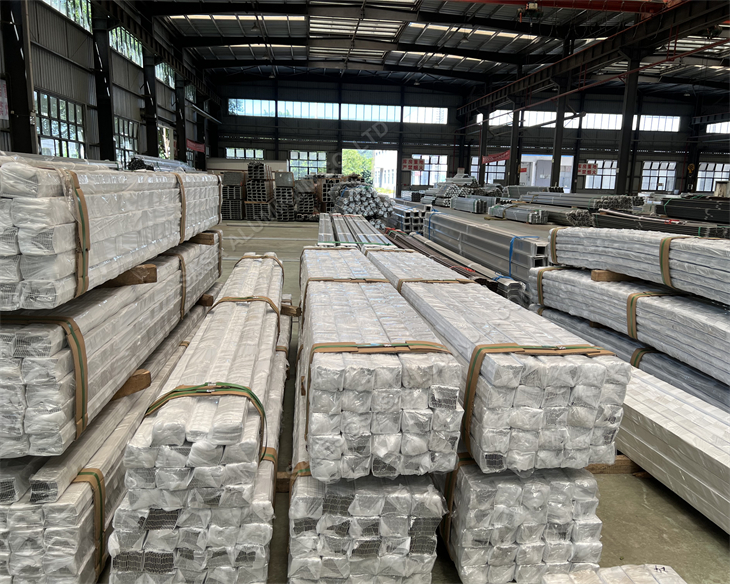
Direct answer: 6082 is an aluminium alloy designation, while 6082-T6 is that alloy supplied in the solution-heat-treated and artificially aged T6 temper. “6082” alone does not define strength, formability, machining stability or acceptance values. A purchase specification should state the complete alloy-temper designation, product form, governing standard, dimensions and required inspection.
6082 and 6082-T6 Are Not Two Different Alloys
| Designation | What it defines | What remains unspecified |
|---|---|---|
| 6082 | The registered alloy composition within the heat-treatable 6xxx aluminium-magnesium-silicon family | Temper, mechanical properties, product form, dimensions, tolerances and inspection |
| 6082-T6 | 6082 alloy solution heat treated and artificially aged | Product-specific property limits, section range, tolerances, surface and documentation |
T6 describes the thermal condition, not one universal production cycle that buyers should prescribe without process qualification. The producer controls solution treatment, quenching and ageing to meet the mechanical-property and dimensional requirements of the ordered specification.
How T6 Changes 6082 Performance
Strength and Hardness
Artificial ageing develops strengthening precipitates in the 6082 alloy system. T6 is therefore commonly selected when higher yield and tensile strength are required than in annealed or naturally aged conditions. The applicable minimum values must come from the selected product standard and size range; values for an extrusion cannot automatically be applied to plate, forging or tube.
Formability
Higher-strength T6 material generally provides less forming margin than softer conditions. When severe bending or forming is required, O or T4 may be considered if the product form and manufacturing sequence allow it, followed by a qualified route to the final condition. Bend radius, section geometry, grain direction, edge quality and tooling must be validated for the actual component.
Machining and Dimensional Stability
6082-T6 is frequently used for machined components, but T6 alone does not guarantee low residual stress or distortion-free machining. For parts requiring heavy or asymmetric stock removal, a stress-relieved temper such as T651 or T6511 may be more appropriate where available for the product form. The suffix, stretching route, dimensional tolerance and machining allowance should be written into the RFQ.
6082 Temper Options Buyers Commonly Compare
| Temper | Condition | Typical selection question |
|---|---|---|
| F | As fabricated, without special control of the thermal condition | Are mechanical-property limits required by the drawing or standard? |
| O | Annealed, lower strength and greater forming capability | Will the component be formed before the final heat-treatment condition? |
| T4 | Solution heat treated and naturally aged to a substantially stable condition | Is additional forming required before artificial ageing? |
| T5 | Cooled from an elevated-temperature shaping process and artificially aged | Does the product standard and section support the specified T5 properties? |
| T6 | Solution heat treated and artificially aged | Are strength, forming and welded-joint requirements compatible? |
| T651 / T6511 | Solution heat treated, stress relieved by stretching and artificially aged, subject to product-form definitions | Is machining distortion or straightness control a critical acceptance issue? |
Welding 6082-T6: The Heat-Affected Zone Controls
6082 can be welded using qualified procedures, but welding heat changes the precipitation-hardened condition near the joint. The heat-affected zone normally has lower strength than the unwelded T6 parent material. A structural design must therefore use applicable welded-joint properties and code rules rather than the mill-certificate T6 value for the entire assembly.
- Confirm the design code and required joint efficiency.
- Select filler metal for the base alloy, service, strength, corrosion and finishing requirements.
- Control heat input, joint sequence, restraint and distortion.
- Define whether post-weld heat treatment is practical and qualified for the complete assembly.
- Specify visual, dimensional or NDT acceptance where required.
Product Form and Standard Change the Property Limits
6082 is supplied in forms including extruded bar, rod, profiles and tube, as well as plate and other products where supported by the applicable standard. Common routes may include EN 755 for extruded products, EN 485 for sheet and plate, ASTM B221/B221M for extruded bars, rods, wire, profiles and tube, and ASTM B241/B241M for seamless pipe and tube. The specified edition, temper and dimension range determine the applicable acceptance values.
For structural sections, review the 6082-T6 aluminium extrusion profiles page and send the drawing. Profile geometry, wall-thickness variation, straightness, twist, corner radii, quench capability and final temper must be reviewed together.
6082-T6 RFQ Checklist
- Alloy and full temper, including any stress-relief suffix
- Product form and governing standard with required edition
- Drawing, section dimensions, thickness, width, length and quantity
- Dimensional tolerances, straightness, twist, flatness and surface requirements
- Forming, welding, machining, anodizing or coating operations
- Mechanical-property direction and any special acceptance values
- MTC, heat/lot traceability, dimensional report and inspection requirements
- Packing method and destination country
Request a 6082 Material Review
Send the complete drawing or purchase specification. SASA ALUMINUM can review the requested alloy, temper, product form, dimensions, fabrication route and testing scope before confirming supply feasibility and quotation.
Post time: Dec-26-2023